

Hey folks, if you're knee-deep in the world of industrial monitors, industrial touch screens, or sourcing reliable IPS LCD panels for HMIs, control systems, or factory kiosks, you've likely had the IPS vs VA debate more times than you can count.
As of January 2026, the shift is pretty clear: the vast majority of serious industrial applications have moved firmly toward IPS panels. Sure, VA LCD still has its fans for specific niches, but when it comes to real-world reliability on noisy factory floors, collaborative control rooms, or 24/7 operation, IPS LCD wins hands down.
In this deep-dive blog post, we'll break down the key differences, zoom in on viewing angles, color consistency, long-shift eye comfort, and why VA's high contrast often backfires with ghosting issues. We'll keep it real, practical, and backed by what actually matters in industrial environments.
Let's jump in.
Quick Refresher: What Exactly Are IPS and VA Panels?
Both IPS LCD (In-Plane Switching) and VA LCD (Vertical Alignment) are advanced types of LCD panels used in modern displays. The main difference lies in how the liquid crystals twist when voltage is applied.
With IPS panels, the crystals rotate horizontally (in-plane), allowing light to pass through more uniformly. This delivers ultra-wide viewing angles-typically 178° horizontally and vertically-with minimal color shift or brightness loss.
VA panels stack crystals vertically. When no voltage is applied, they block light more effectively, creating deeper blacks and much higher contrast ratios (often 3000:1 or higher, vs. typical IPS 1000:1–1500:1).
On paper, VA sounds amazing for vivid images. But in practice, especially for industrial use, those advantages come with trade-offs that make IPS the smarter pick for most scenarios.
Here are some real examples of IPS panels maintaining perfect visuals even from extreme side angles on industrial touch screens:

Viewing Angles: The #1 Reason Industrial Pros Choose IPS
Picture this: a busy factory floor or control room where operators, supervisors, and maintenance crews all need to read the same industrial monitor from different positions. One person might be standing directly in front, another leaning over from the side, and someone else checking it from 60° away.
IPS LCD panels handle this effortlessly. Colors stay accurate, brightness barely drops, and text remains crisp even at extreme angles. Industrial-grade IPS often holds 85–95% of original performance at 178°-critical for safety and quick decision-making.
VA LCD? Not so much. Beyond 30–45°, you start seeing gamma shifts, washed-out colors, and serious brightness loss (up to 50% in some tests). This leads to misreads, frustration, and potential errors in high-stakes environments.
Manufacturers like Advantech, Truly USA, and others repeatedly point to IPS for collaborative or multi-user industrial touch screens because consistency saves time, reduces mistakes, and keeps everyone on the same page.
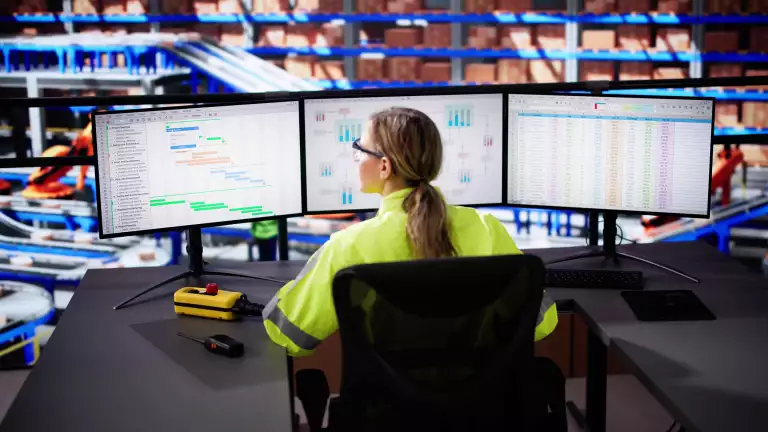
Check out these typical control room setups where multiple operators view screens from various angles-IPS makes it seamless:
Color Consistency & Accuracy: Non-Negotiable for Industrial Work
Many industrial tasks demand precise color interpretation-quality inspections, process monitoring, defect detection, or even medical-adjacent HMIs.
IPS panels deliver rock-solid color accuracy and uniformity. They often cover 95–100% sRGB (with premium ones hitting wide gamuts like DCI-P3), and colors don't shift across the screen or from different viewpoints. Long-term calibration holds up better too.
VA LCD looks punchy head-on thanks to those deep blacks, but colors can appear less precise overall. Off-angle viewing exaggerates the problem-hues distort, details get muddy. In precision-critical industrial monitors, that's a risk nobody wants.
Here's a side-by-side showing how VA suffers from color shift and gamma distortion at angles, while IPS stays true:

Long-Hour Viewing: IPS Wins Big on Reducing Eye Fatigue
Factory shifts, control rooms, and monitoring stations mean staring at screens for 8–12+ hours straight. Eye strain leads to headaches, reduced focus, and lower productivity.
IPS LCD panels reduce fatigue dramatically. Stable brightness, no major shifts, and even light distribution mean less constant adjustment. Many industrial IPS models include flicker-free backlights, low blue light modes, and ambient sensors that adapt automatically.
VA panels might feel immersive initially with high contrast, but angle-dependent changes force squinting or repositioning. Over long periods, this tires eyes faster-especially in shared viewing scenarios.
Studies and user feedback consistently show lower strain with IPS in prolonged professional use.
The Big VA Drawback: Ghosting & Motion Issues in Dynamic Environments
VA's high contrast is great for static dark scenes, but industrial displays often show scrolling data, animated alerts, real-time graphs, or fast-changing parameters.
VA LCD panels commonly suffer from slower response times, leading to ghosting (trailing shadows) or black smearing during motion. This blurs critical info and delays reactions-dangerous in monitoring or interactive touch applications.
Modern IPS handles motion much better (1–5ms GtG with overdrive), keeping everything sharp and responsive.
See the difference in motion handling-VA ghosting shows up clearly in fast-moving data:

High-Brightness Bonus: IPS Thrives in Bright Industrial Settings
Many factories have harsh overhead lighting or sunlight bleed. Industrial IPS panels often come in high-brightness versions (700–1500+ nits) with anti-glare coatings, staying readable where lower-brightness VA might wash out.
These high-brightness IPS setups perform brilliantly in real factory environments:

The Bottom Line: Why IPS Became the Industrial Standard in 2026
In 2026, industrial touch screens and industrial monitors overwhelmingly favor IPS LCD panels. The unbeatable wide viewing angles, consistent color accuracy, reduced eye strain over marathon shifts, superior motion handling, and strong performance in bright conditions outweigh VA's contrast edge in almost every practical scenario.
VA still works for fixed, single-user, dark-environment dashboards where deep blacks matter most. But for versatile, collaborative, safety-focused, or dynamic industrial use? IPS panels are the default choice-and for good reason.
Upgrading or designing your next industrial touch screen? Go IPS-your team, your safety record, and your efficiency will feel the difference.
What's your experience been with IPS LCD vs VA LCD in industrial setups? Drop a comment below-I'd love to hear your stories!
MingHua Display: Premium Custom Automotive LCD Screens
MingHua Display specializes in custom LCD screens for the automotive industry. We offer full flexibility in size, shape, resolution, interface, and features, perfectly suited for car displays - including instrument clusters, center console displays, rear entertainment, and HUD systems.
Our automotive LCD panels use eco-friendly materials compliant with RoHS standards, ensuring sustainability without compromising quality. Built for extreme conditions, they operate reliably from -40°C to +85°C, delivering stable performance in harsh winters or scorching summers - no blackouts or drift.
With ultra-high brightness (1000+ nits) and wide color gamut technology, our screens remain sharp, vivid, and clearly readable even under direct sunlight, enhancing driving safety and comfort.
Choose MingHua for durable, high-performance custom car LCD solutions that help OEMs and Tier-1 suppliers bring smart cockpits to market faster.
Contact us today to start your custom project!


