

What is Capacitive Touch Panel
Capacitive touch panels are made with layers of glass or plastic coated with a conductive material like indium tin oxide (ITO). These layers form an electrostatic field that changes when touched, allowing the screen to pinpoint the location of the contact.
-
![10.1 Inch Capacitive Touch Panel]() 10.1 Inch Capacitive Touch Panel• Size: 10.1 inch• Resolution: 1920 (RGB) × 1200 (WUXGA)• Interface: eDP• Active Area: 216.576 (W) × 135.36 (H) mm• Outline: 228.2 (W) × 149 (H) mm• Brightness: 1000cd/m²• Remark: High brightness,
10.1 Inch Capacitive Touch Panel• Size: 10.1 inch• Resolution: 1920 (RGB) × 1200 (WUXGA)• Interface: eDP• Active Area: 216.576 (W) × 135.36 (H) mm• Outline: 228.2 (W) × 149 (H) mm• Brightness: 1000cd/m²• Remark: High brightness, -
![15.6 Inch Capacitive Touch Panel]() 15.6 Inch Capacitive Touch Panel• Size: 15.6 inch• Resolution: 1920 (RGB) × 1080 • Interface: eDP (2 Lanes), 40 pins, Terminal• Operation Mode: ADS, Normally Black, Transmissive• Active Area: 344.16 (W) × 193.59 (H) mm• Outline:
15.6 Inch Capacitive Touch Panel• Size: 15.6 inch• Resolution: 1920 (RGB) × 1080 • Interface: eDP (2 Lanes), 40 pins, Terminal• Operation Mode: ADS, Normally Black, Transmissive• Active Area: 344.16 (W) × 193.59 (H) mm• Outline: -
![8 Inch LCD Touch Panel]() 8 Inch LCD Touch Panel• Size: 8.0 inch• Resolution: 800x(RGB)x1280• Interface: SPI• Display Mode: IPS• Active Area: 107.64 x 172.22 mm• Outline: 114.70 x 184.25 x 6.00 mm• Brightness: 1500cd/m²• Remark: High brightness,
8 Inch LCD Touch Panel• Size: 8.0 inch• Resolution: 800x(RGB)x1280• Interface: SPI• Display Mode: IPS• Active Area: 107.64 x 172.22 mm• Outline: 114.70 x 184.25 x 6.00 mm• Brightness: 1500cd/m²• Remark: High brightness, -
![8.4 Inch Capacitive Touch Panel]() 8.4 Inch Capacitive Touch PanelSize:8.4inchResolution:1024x(RGB)x768Interface:LVDSDisplay Mode:IPSActive Area:170.50 x 127.87mmOutline:199.50 x 149.00 x 9.70 mmBrightness:1000cd/m2
8.4 Inch Capacitive Touch PanelSize:8.4inchResolution:1024x(RGB)x768Interface:LVDSDisplay Mode:IPSActive Area:170.50 x 127.87mmOutline:199.50 x 149.00 x 9.70 mmBrightness:1000cd/m2 -
![12.3 Inch LCD Bar Type Display]() 12.3 Inch LCD Bar Type DisplaySize:12.3inchResolution:1024x(RGB)x255Interface:LVDSDisplay Mod:IPSActive Area:304.13 x 76.03mmOutline:325.90 x 98.48 x 11.60mmBrightness:500cd/m2
12.3 Inch LCD Bar Type DisplaySize:12.3inchResolution:1024x(RGB)x255Interface:LVDSDisplay Mod:IPSActive Area:304.13 x 76.03mmOutline:325.90 x 98.48 x 11.60mmBrightness:500cd/m2 -
![2.73 Inch Square IPS LCD Touch Panel]() 2.73 Inch Square IPS LCD Touch PanelSize:2.73inchResolution:320x(RGB)x320Interface:SPIDisplay Mode:IPSActive Area:48.96 x 48.96mmOutline:53.36 x 57.49 x 2.15mmBrightness:750 cd/m2
2.73 Inch Square IPS LCD Touch PanelSize:2.73inchResolution:320x(RGB)x320Interface:SPIDisplay Mode:IPSActive Area:48.96 x 48.96mmOutline:53.36 x 57.49 x 2.15mmBrightness:750 cd/m2 -
![2.39 Inch LCD Touch Panel]() 2.39 Inch LCD Touch PanelSize: 2.39Resolution: 256x(RGB)x144Interface: SPI/RGB/MCUDisplay Mode: MONO TFT Active Area: 52.99 x 29.81mmOutline: 57.80 x 38.50 x 2.80mmBrightness: 700cd/m²Remark: High contrast ratio, High
2.39 Inch LCD Touch PanelSize: 2.39Resolution: 256x(RGB)x144Interface: SPI/RGB/MCUDisplay Mode: MONO TFT Active Area: 52.99 x 29.81mmOutline: 57.80 x 38.50 x 2.80mmBrightness: 700cd/m²Remark: High contrast ratio, High -
![3.9 Inch LCD Touch Panel]() 3.9 Inch LCD Touch Panel• Size: 3.9 inch• Resolution: 480x(RGB)x128• Interface: RGB• Display Mode: IPS• Active Area: 95.04 x 25.34 mm• Outline: 105.00 x 36.50 x 2.95 mm• Brightness: 750cd/m²
3.9 Inch LCD Touch Panel• Size: 3.9 inch• Resolution: 480x(RGB)x128• Interface: RGB• Display Mode: IPS• Active Area: 95.04 x 25.34 mm• Outline: 105.00 x 36.50 x 2.95 mm• Brightness: 750cd/m² -
![3 Inch LCD Touch Panel]() 3 Inch LCD Touch Panel• Size: 3.0 inch• Resolution: 180x320• Interface: SPI/RGB/MCU• Display Mode: Mono TFT• Active Area: 37.26 x 66.24 mm• Outline: 42.20 x 75.00 x 2.80 mm• Brightness: 700cd/m²
3 Inch LCD Touch Panel• Size: 3.0 inch• Resolution: 180x320• Interface: SPI/RGB/MCU• Display Mode: Mono TFT• Active Area: 37.26 x 66.24 mm• Outline: 42.20 x 75.00 x 2.80 mm• Brightness: 700cd/m² -
![5.0-Inch TFT LCD Display]() 5.0-Inch TFT LCD DisplayCore Selling Point: Born for one-hand operation, glove touch, sunlight readable, -30 °C instant start. The go-to screen for every logistics scanner, medical portable, drone ground station and
5.0-Inch TFT LCD DisplayCore Selling Point: Born for one-hand operation, glove touch, sunlight readable, -30 °C instant start. The go-to screen for every logistics scanner, medical portable, drone ground station and -
![15.6-Inch Full HD TFT LCD Panel]() 15.6-Inch Full HD TFT LCD Panel15.6-Inch Full HD TFT LCD Panel: Versatile Powerhouse for Demanding Workstations and Control Systems
15.6-Inch Full HD TFT LCD Panel15.6-Inch Full HD TFT LCD Panel: Versatile Powerhouse for Demanding Workstations and Control Systems -
![7.0″ High-Brightness Wide-Temperature TFT LCD Panel]() 7.0″ High-Brightness Wide-Temperature TFT LCD Panel7.0-Inch TFT LCD Display: The Bigger, Bolder Choice for Industrial and Embedded Projects.
7.0″ High-Brightness Wide-Temperature TFT LCD Panel7.0-Inch TFT LCD Display: The Bigger, Bolder Choice for Industrial and Embedded Projects.


The Advantages of Capacitive Touch Panel
Easy To Learn And Use
Capacitive touchscreens feel incredibly intuitive and user-friendly, greatly reducing operation errors. Selecting buttons or menu items is effortless—you simply point and touch. On-screen controls can be sized generously for easy visibility and accuracy, ensuring every user clearly sees and knows exactly where to tap.
Incredible Durability
Capacitive touch screens excel in durability and strength, making them perfect for harsh or high-usage environments. Unlike resistive screens, which wear out in heavily touched areas and become unresponsive, capacitive panels rely on electrical field changes—no mechanical pressure—so they stay reliable with constant use. This makes them far more robust for demanding commercial and industrial applications.
Easy to Clean
Capacitive touch screens with TFT LCD technology feature a tough glass surface on top, making them highly resistant to dirt, rain, grease, and dust. This durability makes them ideal for public installations and heavy-use environments where reliability is essential.
Support Customization
Capacitive touch screens offer a major advantage as all-in-one solutions. Manufacturers can easily customize different sizes to meet specific customer requirements.
They eliminate the need for separate mice or keyboards, saving valuable desk space. By integrating touch input directly into the display, capacitive panels make devices more compact and efficient overall.
Sharper Images With Better Contrast
Capacitive touch screens use a glass top layer, delivering much clearer, sharper image quality compared to resistive screens, which rely on a flexible plastic layer that adds haze and reduces clarity.
If you're watching movies, TV shows, or videos on your device, a capacitive touchscreen is usually the better pick for that crisp, vibrant viewing experience.
Provide Multi-touch Sensing
Projected capacitive touch screens are quite similar to standard capacitive ones, but they stand out by supporting multi-touch. This enables gestures like pinch-to-zoom, swiping, and more, making interactions smoother and more intuitive for users. It's a huge plus for apps needing fluid, multi-finger control.
Types of Capacitive Touch Panel
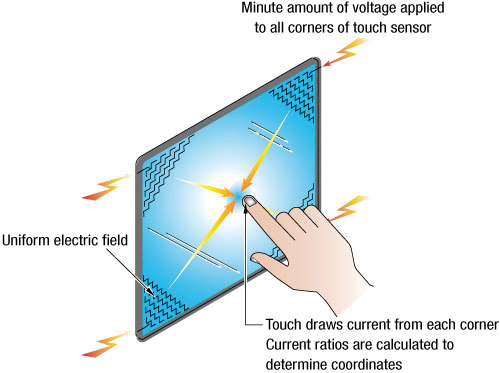
Surface Capacitive
Uses a single conductive layer (like ITO) on glass with four electrodes at the corners. Voltage creates a uniform field; a touch draws charge to detect position. Simple and good for large panels (kiosks), but limited to single-touch and lower resolution.
Projected Capacitive (PCAP)
The most common today (smartphones, tablets). Features a grid of ITO electrodes in rows/columns, forming capacitors at intersections. It supports multi-touch and gestures (pinch-zoom, swipes).
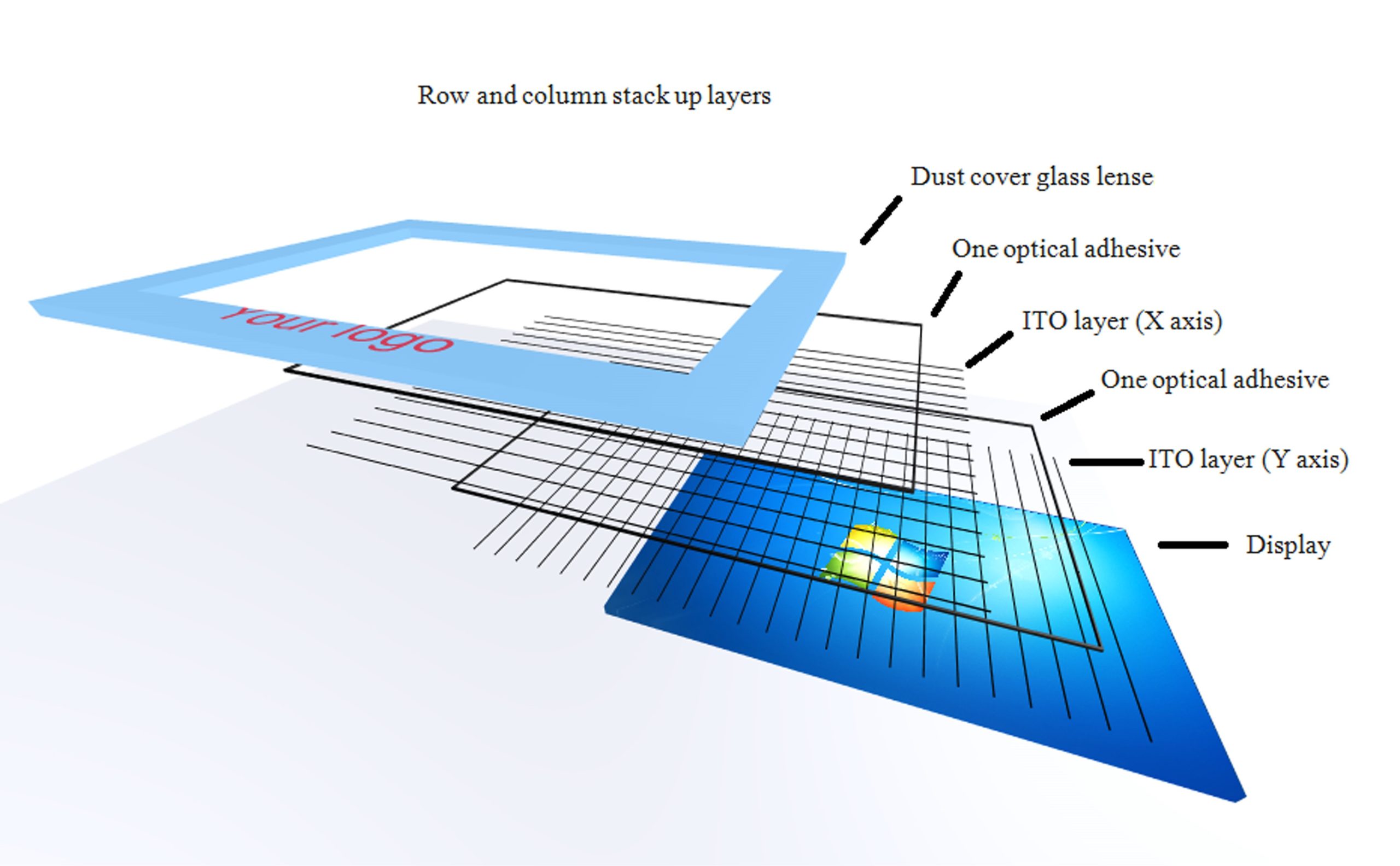
Applications of Capacitive Touch Panels
Consumer Electronics (biggest market share)
Smartphones, tablets, laptops with touchscreens, smartwatches, and interactive smart TVs. PCAP enables pinch-to-zoom, swipes, multi-finger gestures, and precise input—it's basically standard in every flagship phone and tablet.


Industrial & Automation
Human-machine interfaces (HMI), factory control panels, warehouse label printers, 3D printer displays, and machinery touchscreens. High-brightness, wide-temp versions handle dusty, glove-friendly, or 24/7 environments reliably.
Medical Devices
Diagnostic equipment, patient monitors, surgical touch interfaces, and medical tablets. Easy to clean, durable, and precise—critical for hygiene and accuracy in healthcare settings.

How to cooperate with us(customize your own panel)?

Brightness
Indoor screens are fine at 300–500 nits, but outdoor/semi-outdoor/industrial applications regularly demand 800, 1000, 1500, even 3000+ nits.

Touch & Cover Lens
Resistive , Capacitive , or no touch
Cover lens material: Standard tempered glass, Corning Gorilla Glass, acrylic, sapphire glass
Surface treatments: AF anti-fingerprint coating, AG anti-glare, AR high-transmittance, silk-printed black border + logo

Interface & Driver Board
LVDS
eDP
MIPI DSI
HDMI + VGA + DP
TTL/RGB parallel
At Minghua Display, we specialize in custom LCD solutions for demanding applications. We offer tailored TFT LCD panels with 800–2000+ nits high brightness for sunlight readability, wide temperature range (-30°C to +85°C or custom), optical bonding to reduce glare and enhance durability, capacitive/resistive touch integration, anti-reflective coatings, and support for MIL-STD/IP ratings.
We serve industrial, military, printer display, rugged tablet, medical, and outdoor kiosk projects. From prototypes to mass production, we provide short lead times, low MOQs, full engineering support, and traceability. Let us turn your tough specs into reliable displays! Contact us for samples or quotes.


FAQ
Q: Can capacitive screens work with gloves?
A: Standard capacitive screens don't work with thick gloves because gloves aren't conductive. Some industrial or enhanced PCAP versions support glove operation by increasing sensitivity or using conductive gloves/special coatings. Most consumer phones/tablets don't support regular gloves.
Q: Why are capacitive touch panels more expensive than resistive?
A: Capacitive uses more complex layers (ITO grid, precise etching, advanced controllers) and supports multi-touch/gestures with better clarity (fewer layers = higher transparency). Resistive is simpler/cheaper but single-touch, less durable, and hazier—making capacitive the go-to for premium devices.
Q: Do capacitive touch panels suffer from burn-in?
A: No, capacitive touch layers themselves don't burn in—they don't emit light. Burn-in is an OLED display issue from static images. The touch panel is separate and unaffected, though if the underlying display is OLED, the whole screen could show burn-in over time.
Q: Are capacitive screens readable in bright sunlight?
A: It depends on brightness. Consumer screens (500-800 nits) can struggle outdoors. High-brightness versions (1000-2000+ nits) with optical bonding and anti-reflective coatings stay clear in direct sunlight—common in industrial, automotive, or outdoor kiosks.
Q: Does capacitive support multi-touch, and how many fingers?
A: Yes—most PCAP supports true multi-touch (5-10+ fingers). It uses mutual capacitance to track multiple points accurately, enabling gestures like pinch-to-zoom, two-finger scroll, three-finger swipe—standard on phones, tablets, and modern laptops.
Q: How long do capacitive touch panels last?
A: Touch layer life often exceeds 50 million touches. With good glass, optical bonding, and anti-scratch coatings, industrial/military versions can last 8-10+ years in harsh use. Consumer devices typically last 5-7 years under normal conditions.
We're professional capacitive touch panel suppliers in China, specialized in providing high quality customized service. We warmly welcome you to buy or wholesale high-grade capacitive touch panel at competitive price from our factory.
Popular Products


