

On June 4, market research firm Omdia released a new report forecasting that the global OLED laptop display market will reach $4 billion in revenue in 2026, largely driven by the anticipated launch of Apple's first OLED MacBook Pro, which is expected to debut later this year.
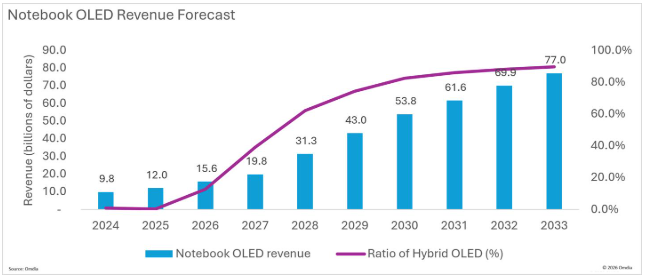
According to Omdia, OLED notebook display revenue is projected to grow significantly over the next decade, reaching $11.5 billion by 2033. By then, laptop OLED panels are expected to account for approximately 16.2% of total OLED display revenue, making them one of the most important growth segments within the IT display market.
Omdia noted that Apple's OLED MacBook Pro is expected to adopt a Hybrid OLED architecture based on Oxide TFT (Oxide Thin-Film Transistor) technology combined with RGB Tandem OLED. This will be the first time such a combination is applied to a display of this size.
Compared with conventional LTPO (Low-Temperature Polycrystalline Oxide) technology paired with a single-stack RGB OLED structure, the Oxide TFT + RGB Tandem OLED approach offers improved power efficiency and better energy management, making it particularly suitable for premium notebook applications.
Over the past decade, most OLED laptop panels have relied on rigid OLED technology, following a development path similar to that of mid-range smartphone OLED displays.
However, as demand for OLED displays in IT devices such as tablets and notebooks continues to rise, panel manufacturers are accelerating investments in Gen 8.6 OLED production lines and adopting a variety of manufacturing technologies, including LTPO and Oxide TFT processes.
For large-size OLED production, display makers are also exploring new patterning methods to improve manufacturing efficiency. In addition to the widely used Fine Metal Mask (FMM) technology, newer approaches such as Inkjet Printing (IJP) and Fine Pattern Mask (FPM) are being introduced to enhance production yields and scalability for larger OLED panels.
One of the key advantages of Hybrid OLED technology is its ability to reduce the space required for display circuitry and batteries, enabling thinner and lighter devices while supporting future form-factor innovations.
Omdia estimates that Hybrid OLED panels will account for 12.6% of OLED notebook shipments in 2026, but this share is expected to surge to 89.5% by 2033, highlighting the industry's transition toward next-generation OLED architectures for premium computing devices.


