

Hey folks, let me ask you something - have you ever looked at a crisp phone screen or a vibrant TV and wondered how it manages to show such rich, lifelike colors? I sure did when I first got into display projects more than a decade ago. Back then, I was mostly focused on the electronics side, but I quickly realized that one of the unsung heroes behind all that color is the Color Filter, or what people in the industry usually refer to as the TFT-LCD Color Filter.
It's funny how something so small and thin can have such a big impact. Without a good Color Filter, even the most advanced liquid crystal layer would only give you different shades of gray. In this article, I'm going to share what I've picked up over the years about how these TFT-LCD Color Filter layers actually work, what they're made of, how they're manufactured, the different types out there, and what the future looks like in 2026. I'll try to keep it practical and honest, based on real project experience rather than just theory.
What a Color Filter Really Does in a TFT-LCD Panel
At its core, a Color Filter (CF for short) is a thin glass sheet with millions of tiny red, green, and blue filters arranged in a very precise pattern. In a typical TFT-LCD panel, it sits right above the liquid crystal material and turns the controlled white light from the backlight into the full-color picture you see.
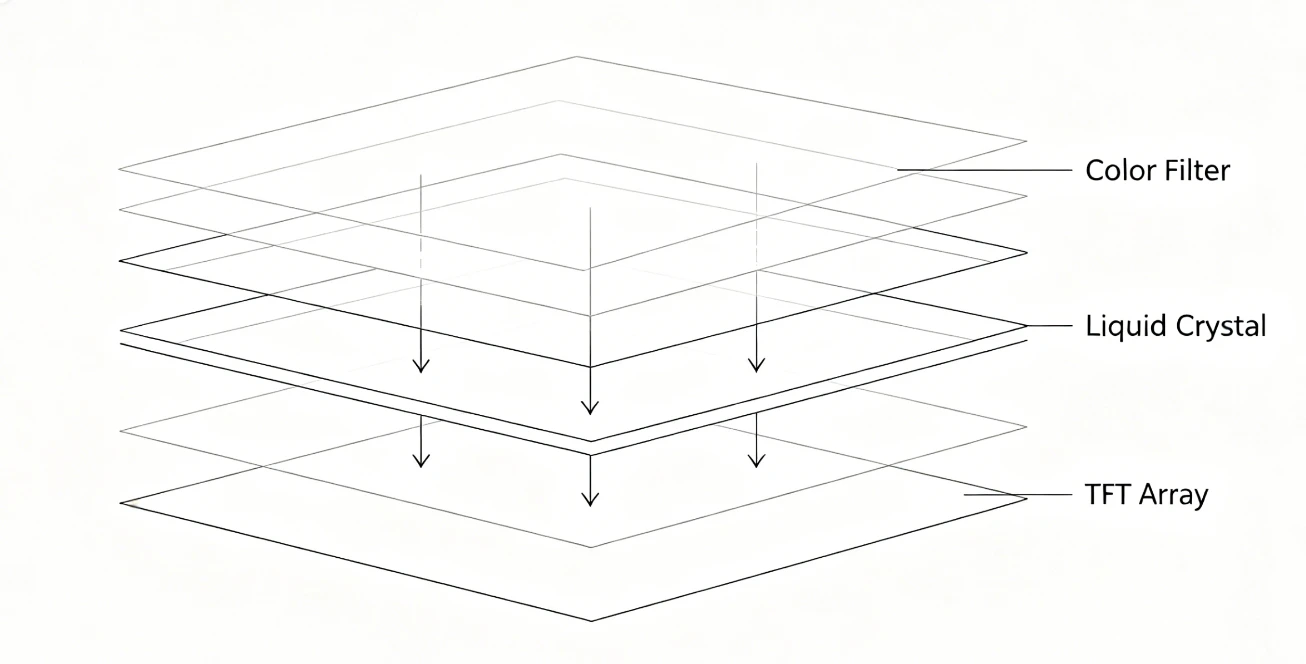
Think of the whole panel like a layered sandwich. The bottom glass has the TFT array - those tiny transistors that switch each pixel on and off. In the middle is the liquid crystal that twists to control light intensity. On top is the Color Filter substrate. If you remove the Color Filter, you basically lose all the color. That's why early LCD screens were mostly monochrome until the technology improved in the late 80s and 90s. Once solid TFT-LCD Color Filter tech became reliable, it helped LCDs take over everything from phones to big TVs.
From what I've seen in actual projects, the quality of the Color Filter directly affects how natural the colors look, how bright the screen feels, and even how much power the whole display ends up using.
How the Color Filter Works in Practice
The basic idea is pretty straightforward. White light comes up from the backlight, gets adjusted by the liquid crystals for brightness, and then passes through the Color Filter.
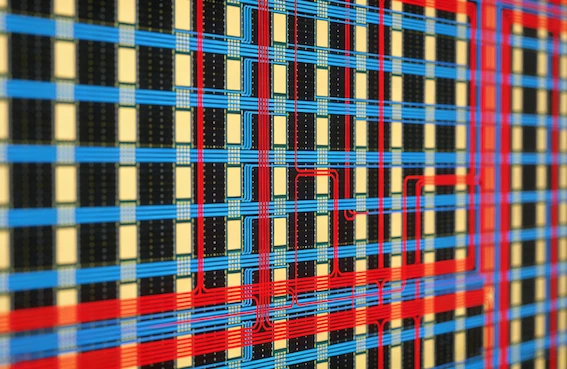
Each full pixel is split into three sub-pixels - red, green, and blue. The red filter lets mostly red wavelengths through and blocks the others. Same thing for green and blue. Your eyes mix those three together, and boom - you see full color. It's the classic additive color system we all learned about in school, but done at a microscopic level.
The full journey of the light usually goes like this: backlight → rear polarizer → TFT array → liquid crystal layer → Color Filter → front polarizer → your eyes. Most screens use the standard RGB Stripe layout, but I've worked with RGBW versions too, which add a white sub-pixel to make bright areas more efficient and reduce power draw.
One detail that often gets overlooked is the Black Matrix. Those thin black lines between the colored blocks are crucial. They stop light from bleeding between sub-pixels, improve contrast, and hide the messy wiring underneath. When the black matrix isn't done right, you'll notice the screen looks a bit fuzzy or the colors bleed into each other, especially on lower-cost panels.
The Materials That Matter Most
After handling quite a few different panels over the years, I can tell you the materials chosen for the Color Filter make a huge difference in real-world performance.

You start with a high-purity, super-flat glass substrate that has to survive multiple coating and baking steps without warping. Then comes the black matrix material - usually a light-absorbing resin these days. Next are the RGB color resists: special photosensitive resins mixed with pigments for each color. They need to let the right wavelengths pass efficiently while blocking the rest, and they have to handle heat without fading.
On top of that, there's a clear protective Over Coat layer to smooth everything out, and sometimes an ITO conductive layer when touch is integrated. Tiny photo spacers are also built in to keep the exact gap between the color filter and the TFT glass.
Lately, the industry has been moving toward greener, more efficient materials. Pigment-based resists have pretty much replaced the older dye types because they last longer and perform better under temperature changes.
The Manufacturing Process – It's More Demanding Than You Think
Making a high-quality Color Filter is one of the trickiest parts of LCD production. The main method is still photolithography - basically using light to pattern incredibly fine details on large glass sheets.
Here's how it usually goes:
First, the glass is cleaned to an almost ridiculous level - any tiny particle can ruin the whole thing. Then the black matrix is coated, exposed, developed, and cured to create the grid. After that, you repeat the coating-exposure-development process three separate times: once for red, once for green, and once for blue. Alignment between these layers has to be extremely precise.
Once the colors are done, they add the protective Over Coat, sometimes sputter on ITO, inspect everything thoroughly, cut the big mother glass into smaller panels, and do final cleaning.
The whole process typically involves 6 to 7 photolithography steps. On large Gen 8.5 or Gen 10.5 glass, even a small misalignment or defect can scrap the entire sheet, so yield rates are always a big concern.
I've seen growing interest in inkjet printing as an alternative. Instead of repeating all those coating steps, they jet the colored inks directly into the black matrix wells. It wastes less material and could simplify things, but it's still being perfected for very high-resolution panels.
Different Types of Color Filters
Not every Color Filter is the same. The classic RGB Stripe is still the most common, but I've come across several variations depending on the application:
- RGBW designs add a white sub-pixel to improve brightness and lower power consumption in bright scenes.
- High color gamut versions use better pigments or quantum dots to show more vivid colors.
- Some are optimized for low reflection (great for cars) or extra durability (for outdoor or industrial use).
- Newer ones even integrate the photo spacers directly into the filter layer.
Quantum Dot Color Filter (QD-CF) technology has been getting a lot of attention lately because it can produce cleaner colors with less wasted light.
The Real Challenges We Still Face
From my experience, TFT-LCD Color Filter technology still has some stubborn limitations. A lot of the backlight energy gets lost as it passes through the filters and other layers, which is why brightness and power management are constant topics. Color shift at wide angles and keeping defects low on huge glass sheets are also ongoing headaches. Plus, building new production lines is extremely expensive.
Right now in 2026, the Color Filter isn't being replaced - it's being improved. Quantum dot combinations, better inkjet processes, and tighter integration with Mini LED backlights are giving LCDs a new lease on life. Companies like BOE and CSOT have been investing heavily and are pushing a lot of this forward. For many practical applications, advanced LCDs with good TFT-LCD Color Filter tech still offer the best mix of cost, brightness, and reliability.
Final Thoughts
The Color Filter might be just one thin layer, but it's the part that brings real color into our everyday screens. After working with these things for years, I still appreciate how much precision and clever engineering goes into something we usually don't even think about.
If you're involved in any kind of display project, taking time to understand TFT-LCD Color Filter technology can really help you make better choices.


At Minghua, we specialize in custom LCD business. We work with clients on both off-the-shelf and fully customized LCD modules, including ones with advanced color filter solutions for consumer electronics, industrial equipment, automotive displays, and more. We focus on delivering reliable quality, practical lead times, and making sure the display actually fits what your project needs - from early samples all the way to mass production.
If you're dealing with a display-related challenge or just want to talk through options, feel free to reach out. I'm always happy to chat and see how we can help.
FAQ
Q: What does the Color Filter actually do?
A: It turns white backlight into red, green, and blue light so we can see full colors.
Q: How many photolithography steps are normally needed?
A: Usually 6 to 7 steps for the black matrix and the three RGB colors.
Q: What's the advantage of QD-CF over traditional filters?
A: Better color purity and improved light efficiency.
Q: Why is the Black Matrix important?
A: It prevents light leakage, boosts contrast, and hides the circuitry.
Q: Can Color Filters be customized?
A: Yes, quite a bit - from color performance to special features.
Q: Are Color Filters going away because of OLED?
A: Not anytime soon. They still win in many applications for cost and brightness.
Q: What's one of the hardest parts of making them?
A: Achieving precise alignment and high yields on large glass sheets.
Q: Is inkjet printing the future?
A: It looks very promising for reducing waste and simplifying production.


