

Hey folks, let me tell you about a real headache I dealt with a couple years back. We had a batch of tablets for an industrial client where the touchscreens looked perfect on arrival, but after a few weeks in the field, operators started complaining that the screens would miss taps or register ghost touches in the cold morning shifts. Turns out, some subtle bonding issues and coating problems slipped through. That experience taught me how critical a solid capacitive touch screen inspection specification really is.
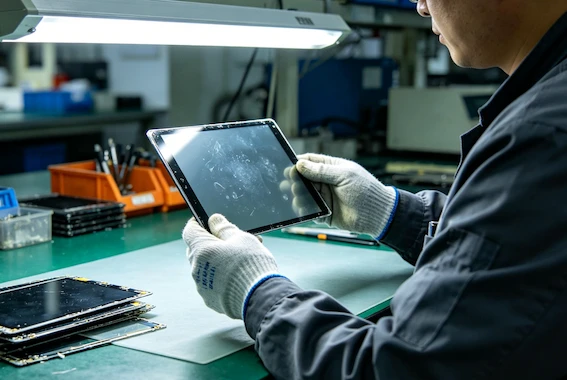
If you're buying, testing, or managing quality for touch panels in phones, car dashboards, or factory equipment, you know the pain. One bad batch and you're facing returns, angry customers, and reputational damage. In this post, I'll share what I've learned from over a decade working as a display quality engineer - walking through the kind of capacitive touch screen inspection standards that many companies put into practical 13-page documents. We'll cover capacitive touch screen appearance inspection, electrical and optical performance, and the tough reliability tests that separate good panels from the ones that fail early.
What Is a Capacitive Touch Screen Inspection Specification, Anyway?
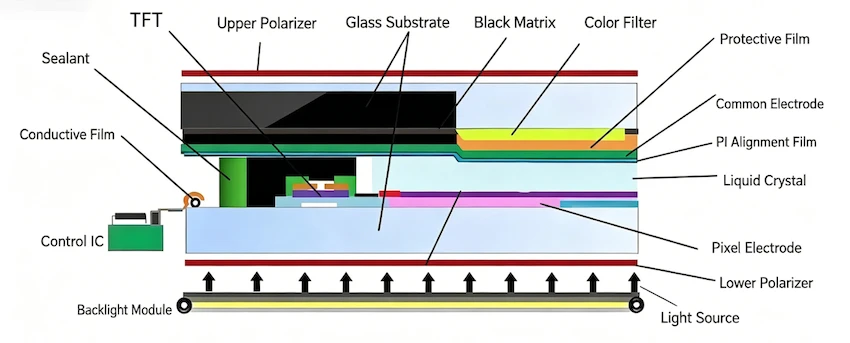
A capacitive (or projected capacitive/PCAP) touch screen works by sensing the tiny change in electrical capacitance when your finger - which conducts electricity - gets close to the layered electrodes on the glass or film. No pressure needed, which is why it feels so natural for swiping and pinching.
The inspection spec pulls together rules from places like IEC 62908 for touch module durability, GB/T standards in China (including newer ones like GB/T 46022-2025 for automotive cover glass), ISO guidelines, and whatever specific requirements your customer or supplier adds. A typical 13-page version exists because these screens are complicated sandwiches: cover glass, sensor film, controller IC, optical bonding, and more. Miss one detail and it cascades.
From my experience, a good spec standardizes incoming checks, in-process quality, and final shipment. It pushes yield rates toward 98%+, cuts field failures, and keeps the whole supply chain aligned. Without it, you're basically guessing.
Appearance Inspection: Catching What Customers See First
This is where most rejections happen. Customers don't care about fancy specs if they see scratches or spots right out of the box.
In visual checks, we look under controlled lighting (around 500-1000 lux, sometimes in a dark room) with magnifiers or AOI systems. Defects get sorted into points, lines, or areas.
Common issues I've seen a lot:
- Spots and bubbles: In the active area, anything under 0.10mm often gets a pass if isolated. Between 0.10-0.15mm, you might allow just a few with good spacing. Larger or clustered ones? Straight reject.
- Scratches: A thin short one on the edge might be minor, but anything visible in the viewing area or deeper than 0.05mm width usually fails.
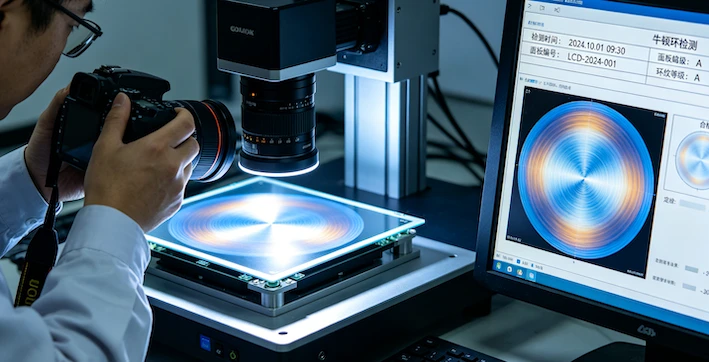
Newton rings (those rainbow interference patterns), foreign particles, or edge chipping on the cover glass.
One time, a supplier had persistent Newton rings because of uneven bonding pressure. We traced it back and fixed their lamination process - yield jumped noticeably after that.
We also check dimensions: overall size tolerances, bezel symmetry, layer alignment (typically under 0.2mm deviation), and edge finishing like chamfering.
Surface treatments matter too. AF (anti-fingerprint) coating should show good contact angle in tests. AR coating needs even performance. A simple wipe test plus visual check catches a surprising number of issues with residue or unevenness.
Electrical Performance: Does It Actually Respond Right?
Looks good? Now test if it works.
Basic checks include operating voltage (common 3.3V or 5V), low power draw, signal-to-noise ratio, and linearity so touches register accurately everywhere.
For touch performance, we test sensitivity with light touches (under 10-20g force), response times under 20ms, multi-touch up to 10 points without ghosts, and behavior with gloves or styluses. I always recommend running these in different environments because a panel that works great in the lab can act up near motors or in humidity.
We log temperature, humidity, and exact conditions for every test. Traceability has saved us more than once when a customer reported an issue months later.

Optical Performance: Making Sure It Looks Sharp
Users notice poor optics immediately - especially in sunlight or bright offices.
We measure transmittance aiming for 85-90%+ with low haze. Color shift (Delta E usually under 2-3), mura (cloudy unevenness), white spots, and brightness uniformity across the panel all get checked with colorimeters and backlighting.
Anti-reflective and anti-glare properties are tested at different angles. A good panel shouldn't turn into a mirror in bright light or show heavy fingerprints after normal use.
Mechanical and Environmental Reliability: The Real Durability Test
This is the heavy lifting part of the 13-page spec - proving the screen will last.
Mechanical tests include millions of touch cycles (good industrial ones often rated over 200 million), sliding abrasion, drop tests, and bending for flexible designs.
Environmentally, we do temperature/humidity cycling - think -40°C to 85°C at 85% RH (the famous "double 85" test common in automotive). Salt spray for outdoor use, thermal shock, and long-term aging. Automotive-grade stuff follows AEC-Q100 and ISO 16750, which are much tougher than consumer specs.
In one project for car infotainment, we ran 500+ temperature cycles. Panels that passed showed far fewer failures in real vehicles later.
Special tests cover glove mode, IP65/IP67 sealing, and EMC immunity per IEC 61000 standards.
Packaging, Shipping, and Final Outgoing Checks
A perfect screen can arrive damaged. We insist on anti-static bags, proper foam, and carton strength. Vibration and drop simulation tests mimic real transport.
Outgoing inspection uses AQL sampling (like 0.65 for critical defects, higher for minor ones per ISO 2859). Critical issues (functional failures) have almost zero tolerance.
Tools, Criteria, and Common Headaches
Typical setup: AOI for visuals, electrical testers, environmental chambers, and drop rigs. Defects are classed as Critical, Major, or Minor.
Real-world problems I've fixed:
- Sensitivity drift from poor grounding or EMI - solved with better shielding.
- Coating wear after cleaning - switched to harder 6H/7H glass.
- High reject rates from one supplier - tightened their process controls and added more frequent audits.
Using statistical process control (SPC) and early supplier involvement helps a ton.
What's Changing in 2026 and Beyond
Foldable and curved screens for cars are pushing new flex durability and vibration tests. Larger automotive panels (12"+) need tighter optical specs and haptic integration. New GB/T standards for automotive cover glass (effective 2026) add more focus on light/heat comfort and smart glass. AI-assisted AOI is becoming standard for faster, more consistent inspection.
Don't try to copy a full 13-page spec on day one. Pull out the key SOPs and checklists that matter for your products. Start with strong incoming visual + electrical sampling, then scale reliability testing for high-stakes items like automotive or medical. Train your team on what "good enough" really looks like in practice.
Getting capacitive touch screen inspection norms right - from appearance all the way to reliability - makes a massive difference in product quality and customer satisfaction. It's not glamorous work, but skipping steps almost always costs more later. Take what fits your situation and build a practical system. Your future self (and customers) will thank you.
FAQ
Q: What does a capacitive touch screen inspection specification usually include?
A: Pretty much everything: appearance, electrical behavior, optics, mechanical durability, and environmental stress tests.
Q: Most common appearance defects?
A: Scratches, spots/bubbles, and coating issues. Size, location (especially in the active area), and quantity decide if it passes.
Q: How do you test touch sensitivity?
A: With calibrated tools simulating fingers, gloves, etc., measuring speed and accuracy under real conditions.
Q: How many cycles for temperature testing?
A: Often 100-500+ depending on the application - automotive might go much higher per AEC standards.
Q: How does AQL work here?
A: It sets sample sizes and defect limits for batches. Stricter for important flaws.
Q: Is car-grade inspection tougher?
A: Absolutely. Wider temperature ranges, vibration, and longer life expectations.
Q: How to know if a report is solid?
A: Clear pass/fail on all key tests, defect rates under limits, and full data backup.
Q: Big changes coming in 2026?
A: More focus on curved/foldable designs, new automotive glass standards, and automated inspection tools.
Q: Key equipment for optical checks?
A: Spectrophotometers and color analyzers are must-haves.
Q: Quick ways to boost yield?
A: Fix issues at the supplier early, control processes tightly, and learn from every rejected batch.


At MINGHUA, we specialize in custom LCD modules and capacitive touch screen solutions for all kinds of applications. Whether you need industrial panels that survive tough environments, automotive-grade displays, or consumer products with tight quality specs, we handle the full process - including rigorous inspection aligned with these standards. If you're working on a new project and want a reliable partner who understands these details firsthand, drop us a message. We'd be happy to help make your product stand out.


