

Hey, if you're reading this, there's a good chance you're dealing with an LCD Module right now - maybe for a new product you're designing, or perhaps you're just trying to understand why your device's screen behaves the way it does. I've been involved in display projects for quite a while, from small prototypes to larger industrial setups, and I still remember how confusing it was the first time I had to spec one out. There's a lot more to it than just "a screen."

In this article, I'll share what I've learned about LCD Modules - what they actually are, how they're built inside, the materials that matter, the different types available, where they get used in real life, and some thoughts on choosing the right one. I'll keep it straightforward, based on hands-on experience rather than textbook theory.
What an LCD Module Really Is
An LCD Module is essentially a complete display unit that's ready to drop into a product. It's more than just the LCD panel you might see in diagrams - it includes the panel, the backlight system, the driver electronics, connectors, and usually a frame to hold everything together.
A common mix-up is thinking the bare panel and the full module are the same thing. The panel is the core part where the liquid crystals do their magic, but the module adds all the supporting pieces so engineers don't have to source and assemble everything separately. That integration is a huge time-saver. In most of the projects I've worked on, using a ready-made LCD Module meant we could focus on the actual product instead of fighting with display integration issues.
LCD tech has been around since the 1970s in simple forms, but today's versions are far more capable. Even in 2026, with newer display technologies getting attention, LCD Modules remain popular because they're reliable, relatively affordable, and bright enough for many real-world situations.
Inside an LCD Module: How It's Actually Built
When you open up (or rather, look at teardown photos of) a typical LCD Module, you see a stack of layers that have to work perfectly together.
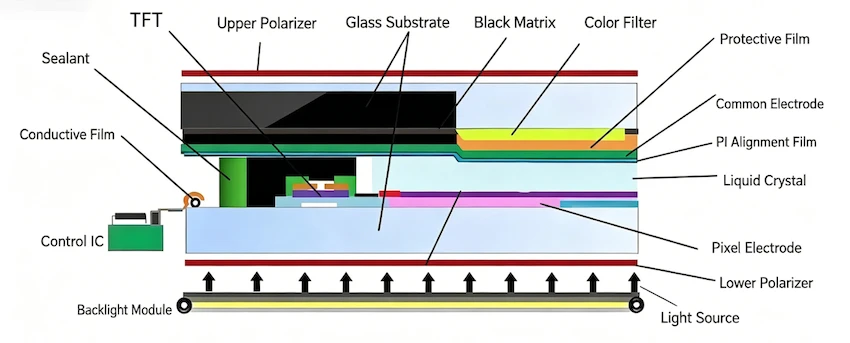
The heart is the LCD panel: two thin glass sheets with liquid crystal fluid sandwiched between them. One side has the TFT array that controls each pixel individually, and the other has color filters. Polarizers on the front and back control light direction.
Behind that is the backlight. Liquid crystals don't make their own light, so this part is crucial. Most modules now use LED backlights - sometimes edge-lit with a light guide plate that spreads the light evenly across the screen, plus diffusers and prism sheets to improve uniformity and brightness. There's also a reflector to catch any wasted light.
The electronics side includes driver ICs (source drivers for data and gate drivers for scanning rows). These are often attached directly using COG (Chip on Glass) for smaller sizes or COF (Chip on Film) for bigger or higher-resolution ones. A flexible circuit (FPC) connects the module to the main board.
Finally, there's the outer structure - metal or plastic bezel - and often a touch layer. Touch can be added as a separate film stack (like G+F+F), or integrated more closely with On-cell or In-cell methods.
I once worked on a portable device where misalignment in the backlight caused uneven lighting. Switching to a better-integrated module fixed it immediately. That optical path - light passing through all these layers and being precisely controlled - is what makes a good LCD Module look sharp and consistent.
The Key Materials Behind LCD Modules
You can't talk about performance without looking at materials. Here are the ones that actually make a difference:
- Glass substrates: High-purity, very flat glass that survives processing without warping.
- Liquid crystal material: The special fluid that twists or aligns when voltage is applied, letting light through or blocking it.
- Polarizing films: They filter light waves and have a big impact on contrast and viewing angles.
- Optical films: Diffusers and brightness enhancement layers (like BEF) that help spread light evenly and reduce waste.
- LEDs for the backlight, sometimes with quantum dots for better color.
- Driver chips and structural plastics or metals for the frame.
Over the years, I've seen a clear shift toward more environmentally friendly options - lower power consumption, RoHS compliance, and materials that are easier to recycle. This matters a lot when you're designing for global markets.
Different Kinds of LCD Modules
One size definitely doesn't fit all. Here's how they typically break down:
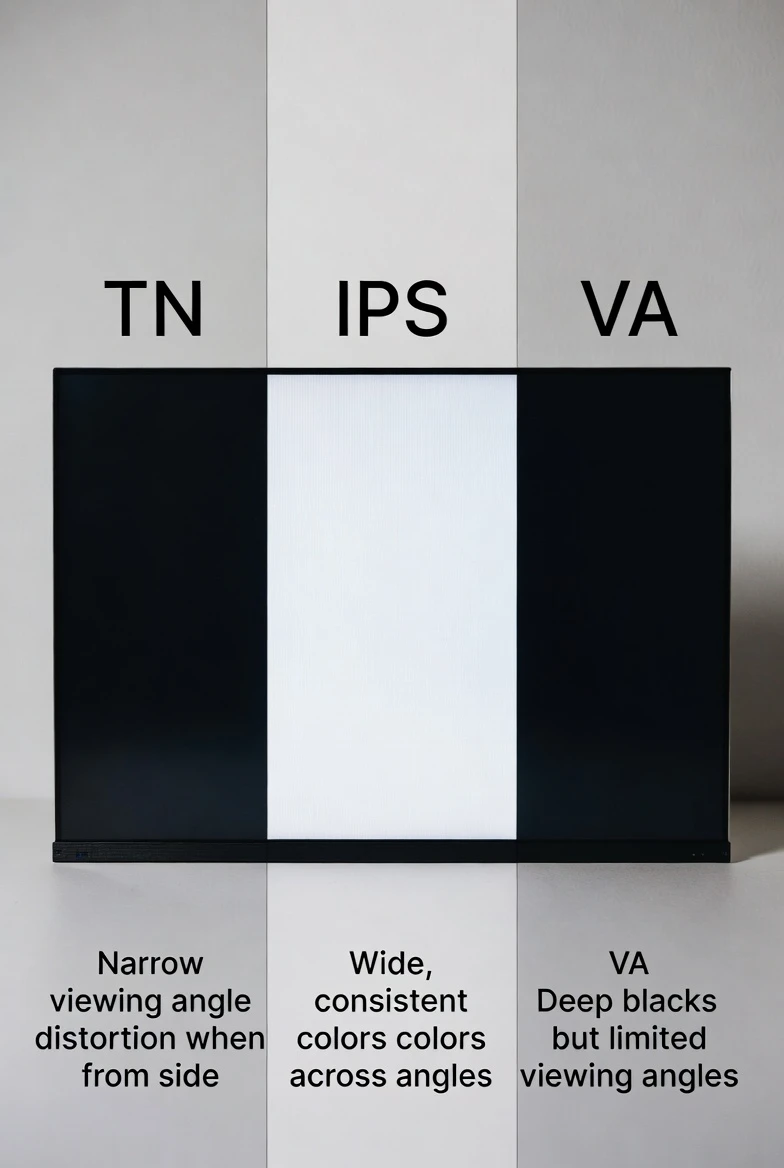
Display Modes
- TN: Fast response, cheap, but limited viewing angles. I still see these in simple industrial readouts.
- IPS: Wide angles and decent colors - this is what most phones and tablets use now. (You'll sometimes hear ADS mentioned; it's a similar wide-angle approach popular with certain manufacturers like BOE.)
- VA: Strong contrast and deep blacks, great for TVs or monitors where you want punchy images.
Assembly and Backlight
COG is common for compact designs, while COF gives more flexibility for larger screens. Backlights are mostly LED now, with Mini LED versions offering local dimming for better contrast in higher-end products.
By size, you have tiny ones for wearables, mid-range for control panels and laptops, and large ones for signage or TVs. There are also niche types like flexible or transparent modules for special projects.
Real Applications I've Seen
LCD Modules show up in way more places than people realize.

In consumer gadgets, they're in phones, tablets, and laptops where balance between quality and battery life is key. In factories, rugged versions power HMI panels that operators use all day in dusty or hot environments.
I worked on an automotive project where the LCD Module had to survive extreme temperature swings and constant vibration - the supplier's automotive-grade version made a big difference. You'll also find them in medical monitors, digital signage at airports, smart home controllers, and even cockpit displays in smaller aircraft.
Tips for Choosing the Right LCD Module
From experience, focus on what your actual environment demands: brightness for outdoor use, wide temperature range for industrial, low power for battery devices, or specific interfaces like MIPI or LVDS.
Don't just chase specs on paper. Think about long-term reliability, availability of support, and whether you need custom tweaks like special coatings or exact mounting holes. A good supplier can save you weeks of headaches here.
Mini LED backlights are becoming more practical, bezels keep shrinking, and efficiency keeps improving. LCD modules aren't the newest kid on the block, but they still win on cost, brightness, and proven durability for many applications. Chinese manufacturers have pushed a lot of this progress forward.
Final Thoughts
After working with dozens of LCD Modules over the years, I've come to appreciate how much careful engineering goes into something that most people never think about. They might not be the most exciting component, but they're solid, practical, and still evolving.
If you're tackling a project that needs a display, take time to understand your options. It really does make a difference in the end result.


At Minghua, we focus on custom LCD solutions. We work with clients on both standard modules and fully tailored designs - whether it's a small screen for a wearable or something more specialized for industrial or automotive use. We pay attention to quality, lead times, and making sure the module actually fits the project requirements. If you're looking for support on your next display need, feel free to reach out. Happy to talk through options and see how we can help.
FAQ
Q: What's the difference between an LCD Module and an LCD Panel?
A: The panel is just the glass core with liquid crystals. The full LCD Module includes the panel, backlight, driver electronics, frame, and connectors, making it ready to install directly into a device.
Q: How long do LCD modules typically last?
A: Most quality modules are rated for 50,000 hours or more under normal conditions. Industrial and automotive-grade versions can last even longer, sometimes exceeding 70,000–100,000 hours.
Q: Is a Mini LED backlight LCD Module worth the extra cost?
A: It depends on your needs. If you want better contrast, local dimming, and HDR-like performance, yes. For basic applications, standard LED backlights are usually sufficient and more cost-effective.
Q: What are the most common interfaces for LCD Modules?
A: MIPI DSI is very popular for small to medium sizes, LVDS for larger displays, and HDMI for high-end or video-heavy applications. The right choice depends on your main board and data requirements.
Q: Can LCD Modules be used outdoors?
A: Yes, but you need high-brightness versions (800+ nits) with anti-glare coatings and wide temperature ranges. Regular modules will struggle in direct sunlight.
Q: What's the difference between On-cell, In-cell, and G+F+F touch?
A: G+F+F is a separate film touch layer (cheaper and easier to customize). On-cell and In-cell integrate the touch sensor directly into the display, making the module thinner and offering better optical performance.
Q: How do LCD Modules compare to OLED in terms of power consumption?
A: LCD Modules generally consume more power when showing bright images but are more efficient for static content. OLED can be better for dark themes but suffers from higher power use in bright environments and potential burn-in issues.
Q: Is it possible to get fully custom LCD Modules?
A: Absolutely. Many suppliers can customize size, shape, brightness, touch, interfaces, and even optical performance. Lead time for custom work is usually 8–16 weeks depending on complexity.
Q: What should I look for when testing LCD Module quality?
A: Check for uniform brightness, dead pixels, color consistency across angles, response time, and heat generation. Reliable suppliers provide detailed datasheets and sample testing support.
Q: Are LCD Modules still relevant in 2026 with newer technologies like Micro LED?
A: Yes. For most practical applications, LCD Modules offer the best balance of cost, brightness, lifespan, and availability. Newer tech is great for premium flagship products, but LCD remains the workhorse for the majority of devices.


