

Why This Comparison Actually Matters Right Now
If you've been looking into displays for an outdoor kiosk, industrial control panel, or commercial signage, you've probably hit the Mini LED versus high-brightness TFT LCD debate pretty quickly. It gets confusing fast, especially when suppliers start throwing around numbers like "10,000 local dimming zones" on one side and "3,000-nit sunlight readable" on the other.
The truth is, both technologies are solid. The real question isn't which one is universally better - it's which one fits your specific project. That's what this guide is for. We'll cut through the hype and look at the practical differences: outdoor visibility, contrast, cost, reliability, and how they hold up in real industrial or commercial use.
This is aimed at engineers, product managers, and procurement folks who need to pick a display for outdoor, industrial, or commercial applications.
What Is Mini LED?
Mini LED isn't a brand-new display type - it's basically an upgraded version of the traditional LCD backlight. Instead of a few big LEDs lighting the whole screen, it uses thousands of tiny LEDs (usually 100–200 micrometers each) arranged in a dense grid behind the panel.
The big deal with Mini LED is local dimming. The backlight is split into hundreds or thousands of independent zones that can brighten or dim on their own depending on what's showing on screen. So a bright moon in a dark sky gets full power in its zone while the surrounding dark areas stay dim. This gives much better perceived contrast.
In marketing speak, you'll see dynamic contrast ratios advertised up to 1,000,000:1, though the actual static contrast is more like 5,000:1. Peak brightness can hit 2,000–4,000 nits, which is great for HDR content.
Quick note: Mini LED is still an LCD at heart - it uses the same liquid crystal layer as regular TFT LCD. The only real difference is the smarter backlight.
Right now, you mostly see Mini LED in premium TVs, high-end monitors, tablets like the iPad Pro, and car dashboards. It's gaining traction wherever you need both high brightness and strong contrast at the same time - something regular LCD has always had trouble with.
What Is High-Brightness TFT LCD?
TFT LCD has been the workhorse of the display world for decades. In a basic TFT LCD, each pixel is controlled by its own thin-film transistor, giving good response times, decent color, and high resolution at a reasonable cost.


A standard indoor TFT LCD is usually 250–450 nits - fine inside, but useless outside in direct sunlight (where ambient light can hit 32,000–100,000 lux and completely wash out the image). That's why high-brightness versions exist.
These panels take a regular TFT and pair it with a much stronger LED backlight that can push 800, 1,000, 1,500, or even 3,000–5,000 nits. At those levels, the screen can compete with bright daylight and stay readable - hence the term "sunlight readable LCD."
It's not just raw brightness, though. Good outdoor TFT LCDs usually combine:
- Dense, high-efficiency LED backlights
- Optical bonding (filling the gap between panel and glass to cut reflections - an 800-nit bonded screen can beat a 1,200-nit air-gapped one)
- Anti-reflective coatings (dropping surface reflection from ~4% down to 0.2–0.5%)
- IPS panels for wide 178° viewing angles
- Wide operating temperature ranges, often -30°C to +85°C
The goal is to keep effective contrast above 5:1 even in direct sun - the minimum for readable outdoor performance. This makes high-brightness TFT LCD the go-to for outdoor kiosks, gas stations, EV chargers, transportation signs, and industrial HMIs.
Key Differences Between Mini LED and High-Brightness TFT LCD
1. How They Actually Work
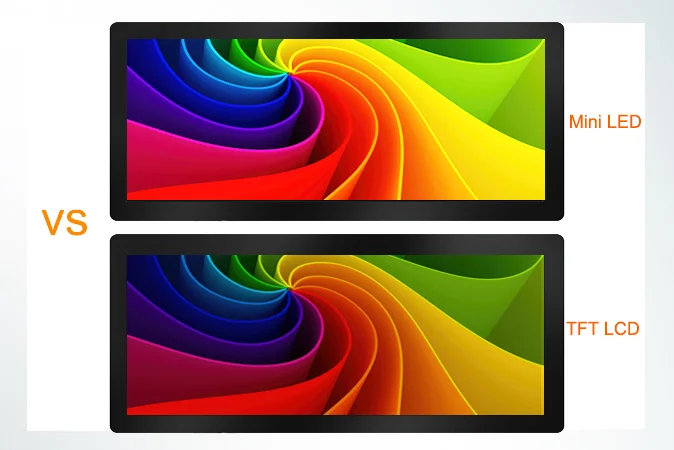
Both use the same TFT liquid crystal layer on top. The difference is in the backlight. Regular high-brightness TFT LCD uses a uniform backlight (edge-lit or full-array) that adjusts as a whole. Mini LED uses thousands of tiny LEDs divided into local dimming zones that can be controlled individually.
2. Brightness
Both can get very bright. High-brightness TFT LCD is designed for sustained full-screen brightness in tough outdoor conditions, often reaching 1,000–5,000 nits. Mini LED can hit 2,000–4,000 nits too, but the brightness is distributed unevenly across zones to create HDR "pops." For consistent full-screen outdoor use, purpose-built high-brightness TFT LCD usually has the advantage.
3. Contrast and Image Quality
This is where Mini LED shines. Local dimming lets dark areas stay truly dark while bright parts pop, getting closer to OLED quality without the burn-in risk. On a standard high-brightness TFT LCD, blacks often look like dark gray because the backlight is uniform.
The downside of Mini LED is blooming (or halo effect): when a small bright object sits on a dark background, light from its zone can spill into neighboring areas, creating a faint glow. It's one of the main limitations, especially on earlier implementations.
4. Power Consumption
High-brightness TFT LCDs at 2,000–3,000 nits use more power - no way around it when fighting sunlight. Mini LED can be more efficient because dark areas don't need full backlight power. For 24/7 outdoor signage, though, a good TFT LCD with auto-dimming sensors often keeps power in check.
5. Cost
High-brightness TFT LCD wins here. The technology is mature, supply chains are solid, and production is optimized. Mini LED requires precise placement of thousands of tiny LEDs plus complex zone control, so it's noticeably more expensive - even though costs have dropped some in recent years.
6. Reliability in Industrial Settings
TFT LCD has the edge. It's proven over decades with long backlight life (50,000+ hours), wide temperature tolerance, and plenty of real-world data in harsh environments. Mini LED adds more electronics (extra drivers, zone logic, denser thermal management), which can mean more potential failure points in vibration, extreme temperatures, or dusty conditions.
Mini LED - Pros and Cons
Pros:
- Much better contrast and HDR
- Strong peak brightness (4,000+ nits in spots)
- Improved image quality over regular LCD
- No burn-in risk (unlike OLED)
- Good for automotive and premium applications
Cons:
- Higher cost
- Blooming/halo effect around bright objects
- More complex to design and integrate
- Less proven in tough industrial environments
- Often overkill for basic outdoor signage
- Heavier/thicker in some cases, and limited custom size options
High-Brightness TFT LCD - Pros and Cons
Pros:
- Excellent reliability in industrial and outdoor use
- 1,000–5,000 nits purpose-built for sunlight
- More affordable with mature supply chain
- Long lifespan and wide temperature range
- Highly customizable (sizes, interfaces, touch, etc.)
- Well-understood and easy to support
Cons:
- Lower contrast (blacks look grayish)
- No local dimming
- Higher power at max brightness
- Image quality has a lower ceiling than Mini LED
Which One Is Better for Outdoor Use?
For most outdoor applications in 2026 - kiosks, digital signs, transportation boards, EV chargers, ATMs - high-brightness TFT LCD is still the practical pick.

The main outdoor challenge is beating reflected ambient light. A 2,000–3,000 nit TFT LCD with optical bonding and anti-reflective coating handles the vast majority of real-world conditions just fine.
Rough Brightness Guide for Outdoor:
- 600–800 nits: Shaded or covered areas
- 1,000–1,500 nits: General outdoor, partial shade
- 2,000–3,000 nits: Full direct sunlight (standard for most kiosks)
- 3,000–5,000 nits: Extreme environments (marine, desert, open roadside)
Mini LED makes more sense when image quality matters as much as brightness - like premium retail displays, high-end advertising, or automotive where first impressions count. If your kiosk just needs to show a readable map in sunlight, a solid 2,500-nit TFT LCD with bonding is usually enough and far more cost-effective.
As Mini LED gets cheaper and more rugged, it'll probably become more common in premium outdoor signage in the next couple of years.
For Industrial Applications
In factories, vehicles, or other tough environments, the priority is reliability over flashy picture quality. You need 24/7 operation, wide temperature tolerance, vibration resistance, long parts availability, and predictable maintenance.

High-brightness TFT LCD checks all those boxes. It's the safe, proven choice for HMIs, marine systems, agricultural equipment, outdoor medical carts, and more. Mini LED's extra complexity (more LEDs, drivers, and control logic) can be a liability in harsh conditions, and industrial certifications for it are still catching up.
Most engineers I've seen in this space pick TFT LCD because it's predictable and supportable over a 7–10 year product life. "Exciting" isn't always what you want when downtime costs real money.
Best Choice for Outdoor Kiosks and Commercial Signage

For typical outdoor kiosks (ticket machines, payment terminals, wayfinding, gas pumps, etc.), ask yourself:
- Is it in full direct sun? Then aim for at least 2,000–2,500 nits. A well-bonded TFT LCD usually covers it.
- Does visual wow-factor or brand experience matter a lot? Then Mini LED's contrast and HDR can be worth the extra cost.
- How's maintenance and durability? TFT LCD has more standardized rugged options (IK10 glass, IP66 sealing, etc.).
Bottom line for most commercial outdoor kiosks: high-brightness TFT LCD is still the recommended choice. For premium retail or advertising where the screen itself helps drive attention and sales, Mini LED can justify the premium.
Quick Comparison Table
| Parameter | Mini LED | High-Brightness TFT LCD |
|---|---|---|
| Backlight | Thousands of tiny LEDs + local dimming zones | Standard LED (uniform) |
| Typical Brightness | 1,000–4,000+ nits (peak, zoned) | 800–5,000 nits (sustained full-screen) |
| Contrast | Excellent (up to 1M:1 dynamic) | Good (1,000:1 to 5,000:1) |
| Black Levels | Very deep (zones can turn off) | Dark gray |
| Outdoor Readability | Good (high peak) | Excellent (built for sustained sun) |
| Local Dimming | Yes | No |
| Blooming/Halo | Yes (common limitation) | None |
| Power Use | More efficient on dark content | Higher at max brightness |
| Cost | Higher | Lower |
| Industrial Reliability | Improving, but still maturing | Proven (50k+ hours, wide temp range) |
| Best For | Premium TVs, auto, high-end retail | Outdoor kiosks, industrial HMI, signage |
Wrapping It Up
Mini LED is impressive - the local dimming, contrast, and HDR are a real improvement over standard LCD, and it will only get better and cheaper. It's a strong option for premium automotive, high-end retail, or medical imaging where picture quality is king.
But for the majority of outdoor kiosks, industrial HMIs, transportation signs, and similar applications, high-brightness TFT LCD is still the reliable, cost-effective winner. It's proven, customizable, and gets the job done year after year without drama.
The real answer is always: match the tech to the actual needs - brightness requirements, environment, budget, and how long the product needs to last. If you're still on the fence, talking to a display specialist who understands your exact conditions is the best next step.
Need steady outdoor readability without breaking the bank? Go with high-brightness TFT LCD. Need premium contrast and visual impact? Mini LED is worth considering.

At Minghua Display, we specialize in custom LCD solutions for outdoor, industrial, and commercial applications. From high brightness sunlight readable TFT LCD modules to fully integrated display assemblies with touch, optical bonding, and ruggedized enclosures - we design and manufacture displays built for the real world.


