

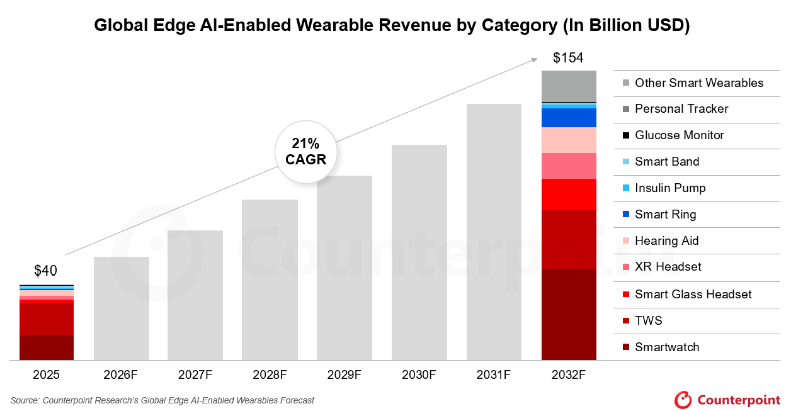
A newly circulated forecast from Counterpoint Research is framing the next decade of wearables not just as a hardware evolution, but as a trillion-dollar gold rush fueled by on-device intelligence. Between 2025 and 2032, the global market is expected to generate a staggering $1 trillion in cumulative revenue-a figure that seems less like a projection and more like a total industry reboot.
At the heart of this surge is a shift toward "Edge AI." While cloud-based processing has defined the last few years, the center of gravity is moving to the wrist, the ear, and the finger. Counterpoint's Global Edge AI Wearables Forecast suggests that by 2032, Edge AI won't just be a premium feature; it will represent roughly 75% of the market's total value.
A Tipping Point in the Silicon
We are looking at an aggressive adoption curve that echoes the early smartphone era. In 2025, we're expecting a 60% year-over-year jump in AI-capable wearable shipments. If these numbers hold, the industry is about to cross a critical threshold where intelligence becomes the default. By 2032, the data suggests that eight out of every ten wearables shipped globally will feature localized AI-a massive leap from the 30% penetration we expect to see next year.
The Rise of the "Invisible" Computer
The heavy lifting in terms of volume will still come from the usual suspects: smartwatches and TWS (True Wireless Stereo) earbuds. The logic here is simple-consumers are becoming increasingly addicted to real-time health metrics and the convenience of low-latency, 24/7 interaction.
However, the real story for many analysts is the "Smart Ring." Though it represents a smaller slice of the current pie, it is positioned to be the fastest-growing segment in the category. The finger remains a goldmine for physiological data, offering a more stable reading than the wrist without the "screen fatigue" or battery anxiety that plagues watches.
The Divergent Growth Paths
The financial disconnect between traditional wearables and AI-integrated ones is becoming impossible to ignore. While the broader consumer wearable market is ticking along at a respectable 10% compound annual growth rate (CAGR), the Edge AI sub-sector is projected to grow more than twice as fast, at a 21% clip.
For manufacturers, the takeaway is clear: the hardware is becoming a vehicle for the algorithm. As we approach 2032, the winners won't be defined by who has the best heart-rate sensor, but by who can process that data most intelligently without ever sending a single packet to the cloud.


