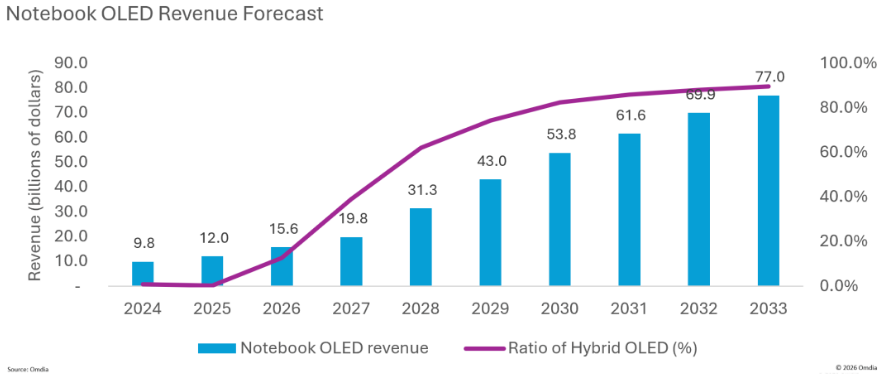
June 5, 2026 - According to the latest data from market research firm Omdia, revenue from OLED display panels for laptops is expected to reach $4 billion in 2026, driven largely by demand from Apple's MacBook Pro lineup. The figure is forecast to grow to $11.5 billion by 2033, accounting for approximately 16.2% of total OLED display revenue.
Omdia noted that over the past decade, most OLED displays used in laptops have been based on rigid OLED technology, following a similar technology roadmap to the OLED panels commonly used in mid-range smartphones.
However, Apple is expected to adopt hybrid OLED technology for future MacBook Pro models. The company is reportedly combining oxide TFT backplane technology with RGB tandem OLED architecture, marking the first time this technology combination has been implemented in a laptop form factor. The design aims to deliver lower power consumption compared with conventional LTPO and single-stack RGB OLED solutions.
According to Omdia, Apple's adoption of hybrid OLED is likely to influence the broader laptop display industry. In the coming years, various technology combinations-including different backplane materials, substrate circuit structures, and OLED patterning processes-are expected to be introduced across the notebook OLED ecosystem.
In particular, demand for hybrid OLED panels is projected to increase significantly through 2033. The technology offers key advantages for notebook manufacturers by reducing the space required for display circuitry and battery components, enabling thinner and lighter device designs while maintaining high display performance.
Omdia forecasts that hybrid OLED panels will account for an increasingly large share of notebook OLED demand, with shipment share rising from 12.6% in 2026 to 89.5% by 2033.
As premium laptop brands continue to prioritize longer battery life, slimmer form factors, and enhanced display quality, hybrid OLED technology is expected to become the dominant solution in the high-end notebook market over the next decade.