

June 4 - According to a post published by renowned Apple analyst Ming-Chi Kuo, Apple's XR headset and smart glasses roadmap now appears to include only two smart glasses products, signaling a major strategic shift away from its current Vision Pro-focused approach.
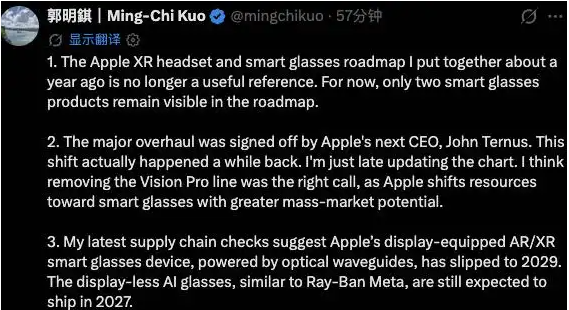
Kuo stated that the adjustment was approved by John Ternus, who is widely considered a leading candidate to become Apple's next CEO. He added that this transition has already been underway for some time.
Regarding the apparent removal of the Vision Pro product line from Apple's long-term roadmap, Kuo described the decision as the right move. In his view, Apple should redirect its resources toward AI-powered smart glasses, a category with significantly greater mass-market potential than premium mixed-reality headsets.
According to Kuo's latest supply chain investigation, Apple's AR/XR smart glasses featuring optical waveguide display technology have been postponed until 2029. The device is expected to rely on advanced optical waveguide systems to deliver augmented reality experiences through lightweight eyewear.
Meanwhile, Apple's display-free AI smart glasses-reportedly similar in concept to the smart glasses developed by Ray-Ban Meta Smart Glasses-remain on track for mass shipment in 2027.
However, Kuo's assessment differs from previous reports by Mark Gurman. Gurman has previously suggested that a lighter and more affordable version of Vision Pro, potentially branded as "Vision Air," could launch in late 2028 or 2029. According to his reporting, the Vision headset category will remain largely dormant until Apple resolves the design, weight, and pricing challenges that limited the commercial success of the original Vision Pro.
The conflicting outlooks from two of the most closely followed Apple analysts have fueled speculation about the company's future XR strategy. Industry observers expect more clarity to emerge during next week's Apple Worldwide Developers Conference, where Apple may provide updates on its spatial computing, artificial intelligence, and wearable device initiatives.
As competition in the AI wearables market intensifies, Apple's long-term success may depend less on high-end mixed reality headsets and more on creating lightweight, consumer-friendly smart glasses capable of integrating AI into everyday life.


