

So you're setting up a cleanroom, or maybe you're dealing with contamination issues in an existing one. Someone suggests using regular industrial computers with fans, and you're wondering if that's really a problem.
Short answer: yeah, it's a huge problem. Let me tell you why.
I spent three months last year helping a pharmaceutical facility troubleshoot mysterious contamination spikes in their compounding room. Turned out to be two "industrial-grade" fan-cooled PCs someone installed near the laminar flow hoods. Once we swapped them for fanless rugged touch screen monitors, problem disappeared overnight.

The Fan Problem Nobody Warns You About
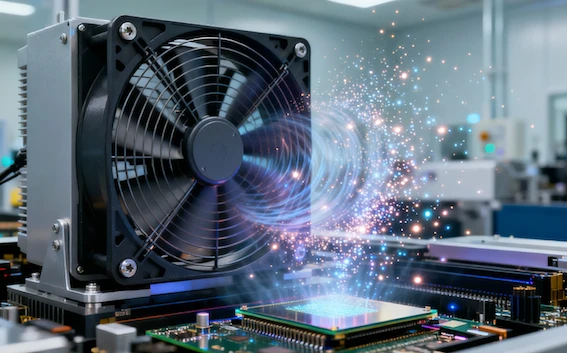
Fans move air. That's literally their job. But in a cleanroom, moving air means moving particles, and that's the last thing you want.
Here's what actually happens: those computer fans are pulling in air and blasting it back out at high velocity. Sounds fine until you realize they're generating anywhere from ten thousand to over a million particles per minute. And I'm talking particles bigger than 0.5 micrometers-exactly the size range cleanrooms are designed to control.
A Class 5 cleanroom (ISO 5 if you're going by international standards) allows about 3,500 particles per cubic meter. One computer fan can blow through that budget in seconds.
I saw this firsthand at a semiconductor fab. They had yield problems in their photolithography area-Class 5 space, everything supposedly by the book. Environmental monitoring kept showing random particle spikes they couldn't trace. Drove everyone crazy for weeks.
Found the culprit eventually: fan-cooled monitoring station someone had installed six months earlier. The fans were creating turbulence that disrupted the laminar flow and kicked up settled particles. Switched to fanless rugged touch screen monitors and the spikes stopped. Just like that.
Fanless Doesn't Mean "Less Fans"-It Means Zero

When I say fanless industrial touch screen systems, I mean actually no moving parts. Not "quiet fans" or "low-speed fans." Zero. Nothing spinning, nothing vibrating, nothing creating airflow.
The cooling happens through big aluminum heatsinks and heat pipes. Same technology I talked about in the other articles, but the payoff in cleanrooms is way bigger than just reliability-it's about not contaminating your environment.
No fan means no particle generation. Period. The computer isn't adding anything to your particle count. For really strict environments-Class 1, Class 10-this isn't a nice-to-have feature. It's mandatory. The math doesn't work otherwise.
Cleaning Fanless vs. Fan-Cooled Equipment (Spoiler: One of These is Impossible)
Cleanrooms need aggressive cleaning. We're talking daily wipe-downs with harsh chemicals, weekly deep cleans, monthly VHP fumigation in pharmaceutical spaces. This destroys regular computers.
The VHP Problem
Vaporized hydrogen peroxide sterilization is standard in pharma cleanrooms. It's basically a fog of hydrogen peroxide that penetrates everywhere, kills everything, then breaks down into water and oxygen.
Great for sterilization. Terrible for electronics with ventilation holes.
I've opened up fan-cooled units after 50-100 VHP cycles. The inside looks like someone left them outside in a coastal city for five years. Corroded circuit boards, oxidized connectors, failed components everywhere. The VHP gets in through the fan vents and just eats stuff.
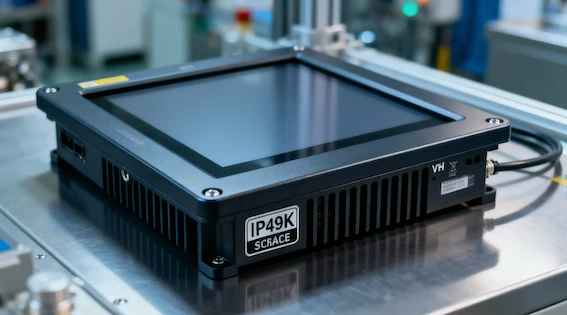
Fanless rugged touch screen monitors with proper IP65 or IP69K sealing? I've seen units with over 2,000 VHP cycles still running fine. Nothing for the VHP to penetrate. The whole thing is sealed up tight.
The Bacteria Hiding Spot Issue
This one's less obvious but just as important. Fan grilles, ventilation slots, the gaps between fan blades-these create little pockets where stuff accumulates. Not just dust. In pharmaceutical and food production cleanrooms, we're talking bacterial growth.
You can't properly clean these areas without disassembling the computer, which obviously you're not going to do inside the cleanroom. So they become permanent contamination reservoirs. I've seen ATP swabs from fan grilles that lit up like Christmas trees.
Fanless systems with smooth stainless steel surfaces? You just wipe them down. No crevices, no hidden areas, nowhere for contamination to hide. Some food processing facilities I work with literally pressure-wash their fanless industrial touch screens every shift. Can't do that with a fan-cooled unit.
Reliability: This One's Not Even Close

Cleanrooms run 24/7. Pharmaceutical compounding, semiconductor fabrication-these operations don't shut down at 5 PM. Your equipment needs to survive years of continuous use.
Fans are the weak link. Always have been. Bearings wear out, usually around 30,000-50,000 hours in my experience. That's 3-6 years of continuous operation. When the fan dies, the whole computer overheats and shuts down in minutes.
And it's never a convenient failure. I've gotten 2 AM calls from facilities where a fan died and took down critical production monitoring. In pharma, that might mean scrapping an entire batch. In semiconductor, could be tens of thousands in wafer losses.
Fanless systems? The passive cooling that works on day one still works identically on day 2,000. Nothing to wear out. I have clients running fanless rugged touch screen monitors for six years straight in ISO Class 100 cleanrooms. 52,000+ hours, zero failures, zero maintenance beyond routine cleaning.
The MTBF numbers back this up-good fanless industrial touch screens are rated over 100,000 hours. That's over 11 years continuous before you hit 50% failure probability.
What About Heat?
"Okay, but without fans, doesn't it overheat?"
Not if it's designed properly. The fanless industrial touch screens I work with use thick aluminum chassis-like 10-15mm in the CPU area-combined with vapor chambers and heat pipes. The entire case becomes the heatsink.
Yeah, the outside gets warm under load. Maybe 50-60°C. But that's fine-it means heat is getting OUT, which is the whole point. And the CPU stays in its safe operating range, no throttling.
The key is matching the TDP to the cooling capacity. A properly designed fanless system can handle 35-65W continuous load no problem. Some high-end ones push 80W, though that's getting to the edge of what passive cooling can do.
Different Cleanroom Types, Same Solution
Pharmaceutical Compounding
USP standards require ISO 7 or better for most compounding work. Fanless touch screens work great here-pharmacists can access formulas and batch records without taking off gloves or using separate keyboards that are hard to sanitize.
Plus the stainless steel construction holds up to daily cleaning with quaternary ammonium compounds or bleach solutions. Had one compounding pharmacy tell me their previous computers lasted maybe 18 months before cleaning chemicals degraded the plastics. Switched to stainless fanless units, still running fine after four years.

Semiconductor Fabs
The really advanced fabs are pushing toward Class 1 (ISO 3) for critical process areas. At that level, you literally cannot use anything with moving parts or airflow. Fanless isn't preferred-it's the only option.
Even in Class 10/100 areas, fan-cooled computers create localized turbulence that screws up the laminar flow. Engineers hate that. Predictable, stable airflow is critical for process consistency.

Biotech and Cell Culture
Laminar flow hoods and biosafety cabinets create super controlled airflow for working with cell cultures. Putting a fan-cooled computer anywhere near these disrupts the flow pattern and risks contamination.
Fanless rugged touch screen monitors can sit right next to or even inside the controlled area without affecting anything. I've seen setups where the touchscreen is mounted directly on the hood frame for protocol access during procedures.

What to Actually Look For When Buying
Not all "fanless" systems are created equal. Some are just regular computers with the fan unplugged and the CPU throttled way down. That's not a real solution.
Check the thermal specs. Ask for sustained load testing data. The system should maintain full CPU performance for hours without throttling. If they can't provide that data, walk away.
Verify the IP rating. Should be actual IP65 or IP69K certification from a test lab, not just marketing claims. Ask to see the test reports.
Material matters. For pharmaceutical use especially, you want 304 or 316 stainless steel. Aluminum is fine for semiconductor or electronics manufacturing, but pharma needs that corrosion resistance for chemical cleaning.
Touchscreen compatibility. Capacitive screens that work through nitrile or latex gloves. Resistive touch can work but requires more pressure and wears out faster.
Component lifespan. Consumer-grade parts won't cut it. Need industrial temperature range, long product lifecycle support, components rated for continuous duty.
The Cost Argument (And Why It's Wrong)
Yeah, fanless costs more upfront. Usually 20-40% more than an equivalent fan-cooled unit.
But over 5-10 years in a cleanroom:
- No fan replacements (usually needed every 2-3 years)
- No downtime from fan failures
- Fewer contamination incidents
- Less product scrap/rework
- Lower maintenance labor
Every facility I've worked with that actually calculated total cost of ownership came to the same conclusion: fanless pays for itself in 2-3 years, sometimes faster.
That Korean panel manufacturer I mentioned? Six month payback from reduced scrap alone. Didn't even factor in the avoided downtime or maintenance savings.
About Minghua Technology

We build fanless rugged touch screen monitors specifically for cleanroom environments. Fully sealed IP65/IP69K construction, zero particle emission, stainless steel or aluminum depending on your application. We've done installations in everything from pharma compounding rooms to semiconductor Class 1 fabs. If you're dealing with contamination control requirements, we can probably help. Give us a shout and we'll talk through what you actually need-not just sell you the most expensive thing in the catalog.


