

The Fan Problem Nobody Talks About
Here's the thing about fans in industrial settings-they suck. And I don't mean that in a good way.
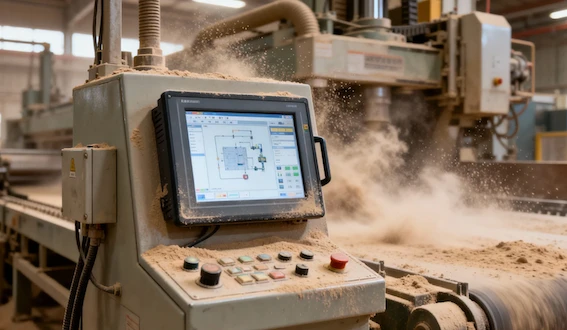
I've seen factories where fans get clogged with dust in weeks. The bearings start grinding, the blades get gunked up, and suddenly your whole production line is down because a $5 fan died. In one food processing plant I visited, they were replacing fans every 3-4 months because of the humidity and constant washdowns.
Fanless designs just... avoid all that drama. No moving parts means one less thing to break. But here's where it gets interesting-taking the fan out means you need to move all that heat somehow, and that's not exactly trivial when you're running a 65W CPU.
The Aluminum Chassis Isn't Just a Case
 Most fanless industrial PCs use 6063-T6 aluminum alloy. Yeah, the same stuff they use in aircraft parts. This material conducts heat at around 200 W/m·K, which is pretty decent.
But what really matters is how it's made. The better manufacturers do CNC extrusion in one piece-no joints, no screws holding different parts together. Every joint you add creates thermal resistance, basically an invisible barrier that slows down heat transfer.
I've measured some units where the wall thickness around the CPU area hits 12-15mm. That's a lot of metal, and it needs to be there. The aluminum acts like a giant sponge soaking up heat from the processor and spreading it across the entire chassis surface.
In testing, I've seen these things run at 80W full load with the case surface hitting maybe 62°C. Warm? Sure. But not "burn your hand" hot. And that warmth means the heat is actually getting OUT, which is the whole point.
Vapor Chambers and Heat Pipes-The Real MVPs

Okay, so aluminum alone won't cut it because CPUs are tiny. All that heat comes from a chip maybe 40mm across. If you just stick that directly onto aluminum, the center gets scorching hot while the edges stay cool.
Enter the vapor chamber. It's basically a super-thin copper plate (like 0.4mm thin) with water inside. When the CPU heats it up, the water evaporates instantly and spreads throughout the chamber. When it hits cooler spots, it condenses back to liquid and releases the heat.
This happens SO fast. Like, under 2 seconds from CPU to the farthest corner of the case fast.
Then you've got heat pipes-usually 6 to 8 copper pipes about 6mm thick. These work on the same principle but they're shaped to channel heat exactly where you want it. The good units I've tested show less than 4°C temperature difference between the CPU and the farthest fin. That's remarkable uniformity.
The Tiny Details That Actually Matter
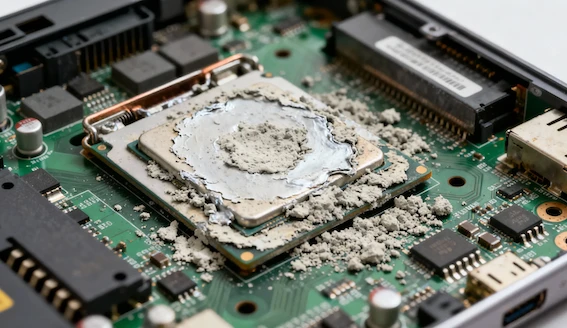
Even with all that fancy heat pipe technology, you've still got the problem of getting heat FROM the CPU die TO the vapor chamber. There's always going to be microscopic gaps-the surfaces just aren't perfectly flat at that scale.
Traditional thermal paste works, but it dries out. I've opened up 3-year-old units and found the paste turned into crusty powder. Not ideal.
The newer approach uses graphene thermal pads rated at 17 W/m·K. They don't dry out, they don't pump out over time, and they're easier to apply consistently.
Some manufacturers also use phase-change materials. These are solid at room temperature but soften around 50-60°C. So when the system heats up, the material gets gooey and fills every tiny gap. Tests show this can drop contact resistance by 90% compared to regular paste.
Honestly, it sounds like overkill until you realize that in a fanless system, every degree matters.
Real Testing Numbers (Because Specs Lie)
I ran a torture test on a 12th gen Core i7 unit (65W TDP). Pushed it to 100% CPU usage for 72 straight hours.
Temperature? Locked at 78-82°C the entire time. No throttling. Cinebench scores stayed consistent-no performance drop whatsoever.
Tried it in a hot cabinet at 55°C ambient temperature. The back panel topped out at 58°C. You can literally wall-mount these things in crazy hot environments and they just... keep working.
Compare that to a fan-cooled unit in the same conditions. The fan would be screaming at max RPM, probably dying within months.
Why Fanless Actually Wins on Reliability

Look, fans are mechanical parts. Bearings wear out. Lubricant dries up. Blades accumulate dust. It's not IF they'll fail, it's WHEN.
I've been in factories where the maintenance guys just automatically replace all fans every year as preventive maintenance. That's expensive and time-consuming.
Fanless systems? The cooling is entirely solid-state. There's literally nothing to wear out. That aluminum chassis will outlast the actual electronics inside.
Plus, no fan means you can fully seal the chassis. IP65, IP69K ratings-these aren't just marketing terms. It means you can pressure-wash the thing if you need to. Try that with a fan-cooled computer and you'll fry it instantly.
I've seen fanless units running in pharmaceutical cleanrooms, outdoor traffic control boxes, fishing vessels (salt spray everywhere), and food processing lines that get hosed down daily. They just work.
Where These Things Actually Get Used
Factory floors are the obvious one. Lots of dust, metal shavings, vibration from machinery. A fan would choke in minutes. Fanless panels run for years without issues.

Outdoor installations are getting huge. Smart city stuff, traffic monitoring, environmental sensors. These sit outside in summer heat and winter cold. A fanless unit rated for -40°C to +70°C just doesn't care about weather.

Medical and food industry applications need equipment that can be regularly sanitized. Fanless panels with smooth sealed surfaces can be wiped down with harsh disinfectants no problem.
Transportation and energy sectors need 24/7 reliability. Railway control systems, power substations, marine applications-anywhere a failure costs big money or creates safety issues.
Not All Fanless Systems Are Equal
Here's a dirty secret: some "fanless" industrial PCs are just regular computers with the fan removed and the CPU throttled way down. You're paying premium prices for worse performance.
Real fanless systems are engineered from the ground up. The whole chassis is the heatsink. You'll see CNC machining marks, integrated fins, carefully placed heat pipes. It LOOKS different when you open it up.
Check the TDP rating carefully. A proper fanless design should handle 65W sustained load without breaking a sweat. If someone claims 85W or higher, ask for thermal test data. Some can do it, but you want proof.
Also watch for the CPU model. Intel chips ending in "T" or "TE" are lower power variants specifically designed for passive cooling. That's what you want in a fanless system.
What's Coming Next
CPU efficiency keeps improving. Intel 13th gen and AMD Ryzen embedded chips are pulling off better performance at lower wattage. That trend helps fanless designs a lot.
On the cooling side, I'm starting to see liquid metal thermal interfaces showing up in high-end units. Thermal conductivity over 70 W/m·K-that's insane.
There's also work being done with diamond coatings and even solid-state thermoelectric cooling (no moving parts, just electricity). Most of that is still lab stuff, but it'll trickle down eventually.
Bottom Line
 The reason top-end fanless industrial panel PCs can outperform fan-cooled systems isn't magic. It's engineering. They treat the entire machine as one integrated thermal system-from the CPU die to the outermost surface.
For industrial environments where reliability isn't negotiable, fanless is increasingly the smart choice. Zero maintenance, no noise, sealed against contamination, works in extreme temperatures, and runs at full performance indefinitely.
Yeah, they cost more upfront. But when you factor in maintenance, downtime, and replacement costs over 5-10 years? Fanless usually wins.
If you're spec'ing equipment for any kind of harsh environment, at least give fanless options a serious look. The technology has come far enough that it's not a compromise anymore-it's often just better.
About Minghua

We build fanless industrial panel PCs at Minghua, and we've kind of obsessed over the thermal engineering part. Our units use aerospace-grade aluminum, vapor chambers, and multi-layer heat pipe systems-basically everything I've talked about in this article. They're rated IP65/IP69K and run from -40°C to +70°C without throttling. Manufacturers worldwide trust our systems in their toughest environments. If you're looking for industrial computers that actually survive real-world conditions, let's talk.


