

Fifteen years ago, I was a green quality engineer in a bustling LCD fabrication plant, surrounded by the hum of machinery and the constant pressure of hitting daily yield targets. Every morning before the shift meeting, I'd spread out printed control charts on the table, trying to explain to the team why a particular process had started drifting. Even back then, SPC in LCD manufacturing was one of the few tools that actually helped us catch problems early instead of dealing with piles of defective panels at the end of the line.

Today, in 2026, the factories are far more automated, with robots handling delicate glass and advanced sensors everywhere. But the fundamental challenge remains the same: tiny, almost invisible variations in the manufacturing process can still snowball into serious quality issues. In this article, I want to share what I've genuinely learned over the years about using Statistical Process Control effectively in LCD production - not just the textbook theory, but the practical realities I faced on the floor.
The Day-to-Day Reality of SPC in LCD Production
Statistical Process Control (SPC) is essentially a set of statistical methods that help you monitor a manufacturing process in real time. It's about understanding the difference between normal, everyday variation that's part of the process and special causes that signal something has gone wrong.

In LCD manufacturing, this is incredibly important. We're working with massive glass substrates, ultra-thin film layers, precise photolithography steps, and liquid crystal alignment that must be almost perfect. A slight temperature fluctuation in a deposition chamber or a tiny misalignment during exposure can create visible defects like mura, color shift, or dead pixels that only show up much later.
I still remember one particular line where we kept seeing intermittent uniformity problems in the thin film layer. Using basic SPC in LCD manufacturing tools, we finally traced it to a slow drift in gas flow rates that the operators hadn't noticed. Fixing that issue prevented weeks of potential scrap. Moments like that made me realize why Statistical Process Control LCD isn't just another quality checkbox - it's a real competitive advantage.
Control Charts and Process Capability: The Tools I Rely On
Over the years, I've become quite familiar with the main SPC tools.
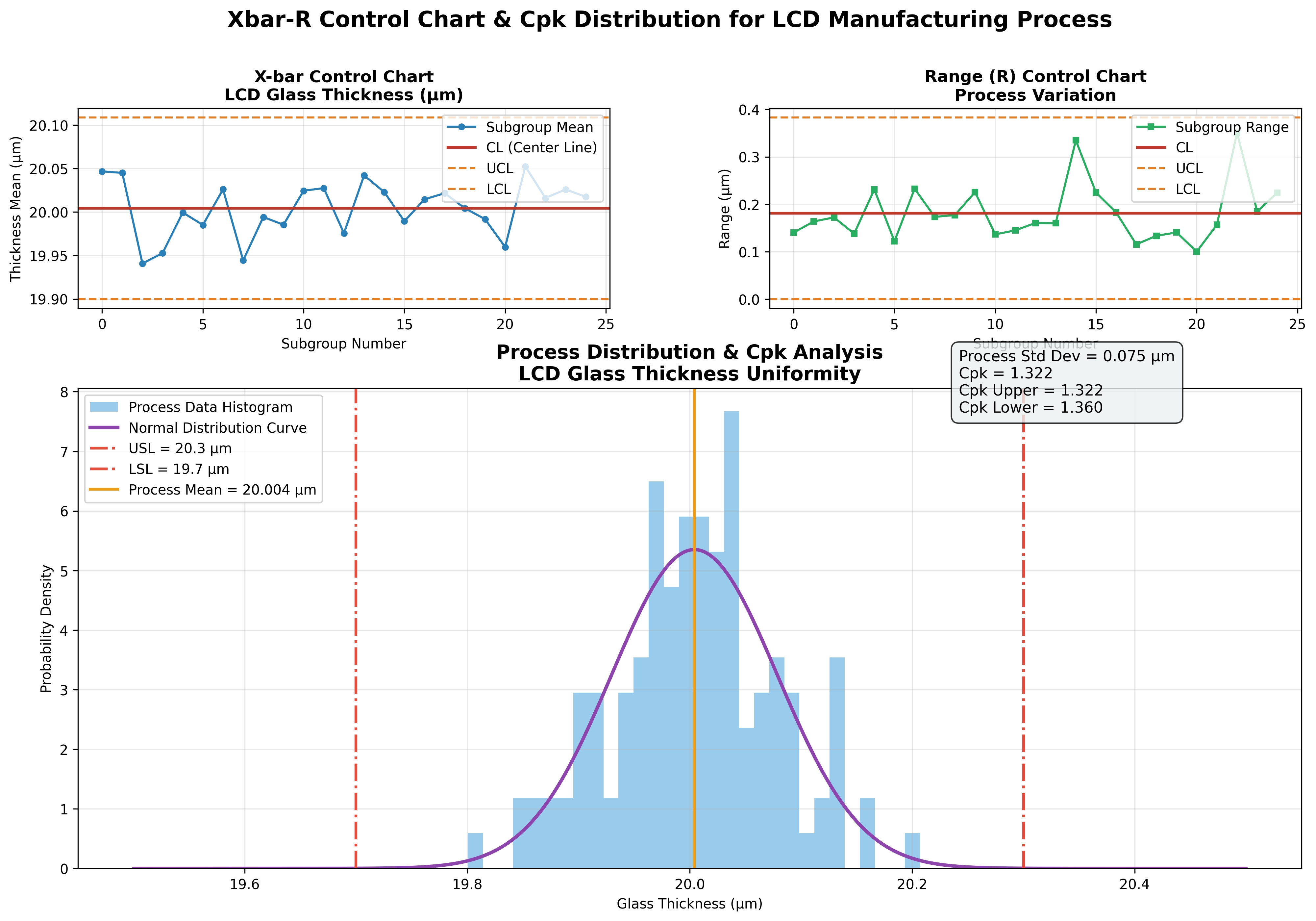
For variables data - things like glass thickness, critical dimensions, or film uniformity - I usually start with Xbar-R charts when we're sampling several panels at once. They give a good view of both the process average and the spread. When we measure every single piece, I-MR charts (Individual and Moving Range) become more practical.
For counting defects - particles, scratches, or bad pixels - I turn to attribute charts: p-charts for the proportion of defective units or u-charts when I need defects per unit area.
But charts alone aren't enough. That's where process capability indices come in. I've always paid close attention to Cpk because it tells you whether your stable process is actually capable of meeting customer specifications consistently. In LCD work, I learned the hard way that a process can look perfectly "in control" on the chart but still have a Cpk below 1.0, meaning you're regularly producing panels that are barely within spec.
I once had to stand in a management meeting and explain why our seemingly stable etching process was still causing customer complaints. Showing both the control chart and the Cpk calculation helped everyone understand we needed to center the process better. That kind of conversation happened more times than I can count.
Why SPC Has Only Grown More Important in Modern LCD Factories
Even with all the automation we have now, variation hasn't disappeared - it's just become more sophisticated. Higher resolutions, larger panel sizes, and stricter customer requirements mean that even smaller shifts can hurt yield and reputation.
I've consulted with several plants that initially underestimated the need for strong SPC for LCD quality control. They relied heavily on final inspection and automated optical systems, but still faced recurring issues. Once they implemented proper monitoring on key process parameters, they started seeing real improvements - sometimes boosting overall line yield by 3-8% and significantly cutting rework costs.
One mid-sized manufacturer I worked closely with focused on their Array process section. After six months of disciplined Statistical Process Control LCD work, their key Cpk values climbed from around 1.15 to over 1.75. The difference in downstream defects was dramatic.
How We Actually Put SPC into Practice on the Floor
There's no magic formula that works for every factory, but here's the approach I've seen succeed most often:
First, identify the vital few processes that impact quality the most - usually things like photoresist coating, exposure alignment, etching, or cell gap control in the assembly stage.
Next, ensure your data collection is reliable. In newer lines, this means integrating sensors directly with the MES system so data flows automatically rather than depending on tired operators filling out forms at the end of shift.
Then establish realistic control limits using sufficient historical data. Train not just engineers but also supervisors and operators to read the charts and understand what different patterns mean.
The real test comes when an out-of-control signal appears. I always encouraged teams to pause and do a proper root cause analysis instead of making quick adjustments that might mask the real issue. Over time, this builds a much healthier problem-solving culture.
I also made it a habit to bring visual SPC examples into monthly management reviews. A simple chart with a real story from the line usually got more attention than pages of dry numbers.
The Benefits I've Witnessed - and the Real Challenges
When done right, SPC in LCD manufacturing delivers lower process variation, more consistent quality, reduced scrap, and better on-time delivery. It also frees up engineering time that used to be spent constantly firefighting.
But I won't sugarcoat it - implementation has its difficulties. Some operators initially saw data collection as extra burden. Engineers sometimes resisted because it made hidden problems visible. Integrating everything with existing automation systems could be technically challenging and expensive at first.
The plants that succeeded treated SPC as a living part of their culture rather than just another reporting requirement. They celebrated small wins when variation decreased and involved people from different departments in the improvement process.
Advanced Practices and What the Future Holds
These days, I see more factories moving toward real-time SPC dashboards that alert engineers instantly when something looks off. Some are even combining traditional control charts with AI to predict potential drifts before alarms trigger.
In LCD-specific applications, I recommend paying special attention to parameters like deposition uniformity in thin film steps, overlay accuracy in lithography, and liquid crystal fill precision. Pairing good SPC practices with Design of Experiments (DOE) has helped many teams I've known speed up process optimization significantly.
FAQ
Q: What's the most common mistake with control charts?
A: Reacting to every single point outside the limits without investigation, or missing slow trends that stay within limits but gradually move away from target.
Q: How does Cpk compare to just having an in-control process?
A: Cpk is crucial. You can have a stable process that still produces too much out-of-spec product if it's not centered properly.
Q: Does SPC still make sense with highly automated lines?
A: Yes - automation actually generates more consistent and abundant data, making SPC more powerful than ever.
Q: How long before you see real results?
A: You can catch some quick wins within weeks, but building a true continuous improvement culture usually takes several months of consistent effort.
Q: Is SPC still useful for newer display technologies?
A: Definitely. Whether it's advanced LCD, OLED, or Mini-LED, the need for process stability at high precision remains.
Final Reflections After All These Years
Looking back on my time in the industry, I'm more convinced than ever that strong SPC in LCD manufacturing is one of the quiet foundations of a successful display factory. It's not the most exciting topic, but the discipline it brings consistently leads to better products, smoother operations, and fewer late-night emergency calls.
If you're wrestling with process variation, yield challenges, or trying to strengthen your quality system, I hope some of these hard-earned lessons from the factory floor prove useful in your own work.


When you need custom LCD solutions engineered with real manufacturing and quality control in mind, MINGHUA is a company worth talking to. They specialize in custom LCD business and have deep experience delivering open frame displays, specialized modules, and complete display solutions that support tight process requirements. Their team understands the importance of consistency and reliability coming straight out of production. If you're exploring options for your next project, reach out to Minghua - practical expertise like theirs often makes all the difference in achieving stable, high-quality results.


