

Hey guys, if you're in the industrial display world, working on outdoor signage, car dashboards, factory HMIs, or anything that needs to be seen clearly even when the sun is blasting right on it - you've probably asked yourself: "Is high brightness LCD really worth the upgrade over a standard one?"
In 2026 (yeah, we're basically there now), with more projects moving outdoors or into super bright environments, high brightness LCD (also called sunlight readable LCD) isn't just nice to have anymore - it's often the make-or-break factor. Standard screens look great in the office, but take them outside? Washed out, hard to read, frustrated users, more complaints, higher costs in the long run.
Today we're breaking it down honestly: high brightness LCD vs standard LCD - 8 real differences you actually need to know before your next spec sheet. I'll pull from real industry tests, factory experiences, and what customers tell us every day at MingHua Display.
Brightness Basics: What Do Nits Really Mean, and When Is It "High"?
First things first - brightness is measured in nits (cd/m², candela per square meter). It's basically how much light the screen pushes out.
- Standard LCD (the ones you see in most offices or consumer monitors): Usually 250–500 nits. Fine indoors, maybe ok near a window.
- High brightness LCD (sunlight readable): Starts at 1000 nits, common range 1000–2500 nits, and we can push custom ones to 3000+ nits or more.
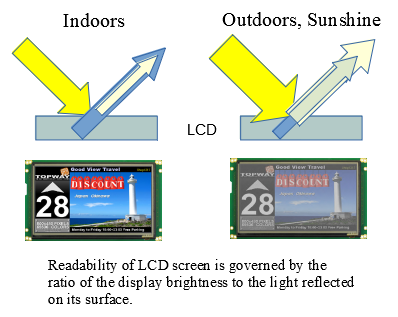
Why does this matter? Ambient light in direct sunlight can hit 10,000–100,000 lux. If your screen is dimmer than the light bouncing off it, everything looks washed out - like trying to read your phone at noon on the beach.
Here are some real outdoor comparison shots (standard on left, high brightness on right - notice how text stays sharp even in full sun):
You can see the huge difference - high brightness pushes the highlights way above the reflected sunlight, keeping contrast alive.
Quick Side-by-Side Comparison Table
Let's make it super easy with a table (based on typical 10–27 inch industrial panels, 2025–2026 real-world data):
| Feature | Standard LCD | High Brightness LCD (Sunlight Readable) | Real-World Impact |
|---|---|---|---|
| Typical Brightness | 250–500 nits | 1000–2500+ nits | 3–5× brighter - game changer outdoors |
| Outdoor Direct Sun Visibility | Washed out / unreadable | Clear & sharp (1500+ nits ideal) | No more squinting or complaints |
| Power Consumption (full brightness) | 5–15W | 15–40W+ | Higher, but smart dimming helps a lot |
| Backlight Lifespan | 50,000–70,000 hours | 50,000–100,000 hours (modern LEDs) | Similar or better with good thermal design |
| Anti-Glare / Optical Bonding | Rarely | Almost always included | Reflection down from ~10% to <1% |
| Cost (relative) | Lower upfront | 30–100%+ more | But total ownership cost often lower |
Data pulled from multiple manufacturers (TRU-Vu, DynaScan, Litemax, RisingStar, etc.) - actual numbers vary a bit by size/tech.
Check this brightness level chart for quick reference:

Real Sunlight Visibility - The Photos Don't Lie
Standard screens look amazing in controlled light, but outdoors? Disaster. High brightness LCDs use stronger LED backlights + optical bonding (glues glass directly to panel, kills air gap reflections) + anti-glare/anti-reflective coatings. Result? Contrast stays high even when ambient light is crazy.
More real factory/outdoor shots (industrial HMI, kiosks, marine displays):

You can actually read the numbers and icons - that's what matters for operators, drivers, or customers.
Durability & Backlight Life - Does High Brightness Kill It Faster?
Common worry: "More brightness = more heat = shorter life, right?" Not anymore. Modern high brightness LCD uses efficient LED backlights + better thermal management (aluminum frames, heat sinks, smart fans). Lifespan is now on par or better than standard ones - often 70,000–100,000 hours.
The real killer is bad design - poor heat dissipation. Good manufacturers (like us at MingHua) pair high brightness with wide temp range (-30°C to +85°C) so it doesn't overheat in summer sun.
Power Consumption - Yes, It's Higher, But...
Full brightness? High brightness draws more power - no way around it. But smart features change everything:
- Ambient light sensors auto-dim when not needed
- Local dimming zones turn down backlight in dark areas
- Run at 70–80% max for most of the day
Many customers find total energy use isn't that bad - especially if the alternative is rework or failed projects.
Cost vs Performance - When Does It Actually Save Money?
Upfront, high brightness LCD costs 30–100% more (depending on nits and size). But look at total cost:
- Fewer returns/complaints
- Less operator errors (one factory dropped 35% mistakes after switching)
- No need for sunshades or extra enclosures
- Better user satisfaction = more repeat business
Real example: An industrial client swapped 400-nit HMIs for our 1500-nit custom units. Initial cost higher, but after 1 year: 35% fewer errors, zero brightness complaints, and they calculated 25–40% lower overall ownership cost.
Real Customer Case: Factory HMI Upgrade That Actually Worked
One of our partners had a production line where strong overhead lights + machine reflections made standard 400-nit screens useless. Workers kept missing alarms - safety issue + downtime. We supplied custom 1500-nit wide-temp panels with optical bonding. Results?
- Alarms instantly visible
- Error rate dropped ~35%
- Operators said: "Finally no more squinting!"
- Running full year with no decay complaints
Wrapping Up: Is High Brightness LCD Right for Your Project in 2026?
Quick checklist - if any of these sound like you, skip the standard screen:
- Any outdoor or semi-outdoor use
- Bright factory floors, warehouses
- Automotive, marine, agricultural equipment
- 24/7 critical industrial HMI
At MingHua Display, we specialize in custom high brightness LCD - 1000–3000+ nits, wide temp, optical bonding, touch integration, any size/interface. Fast lead times, reliable, and we help you pick exactly the right spec so you don't overpay.
Got a project coming up? Drop a comment or message us - happy to do a quick free brightness/visibility assessment for your environment. Let's make sure your screens stay readable no matter what the sun throws at them!
Thanks for reading - hope this helped clear up the high brightness LCD vs standard debate. See you in the next one!


