

Hey everyone, if you've ever shopped for a monitor, laptop screen, or any kind of LCD display, you've probably run into the big debate: which panel type is actually the best? People throw around terms like TN, MVA, IPS, and PLS all the time, but a lot of folks just default to "IPS is king" without really digging in. Back in 2014, when that original Pacific Computer Net article came out, the landscape was already shifting, but fast-forward to today in 2025-2026, and things have evolved even more with modern improvements in response times, color gamuts, and even cost efficiencies.
The truth is, no single panel wins everything-TN crushes it for speed, VA (which evolved from MVA) dominates contrast and deep blacks, IPS nails color accuracy and viewing angles, and PLS (Samsung's take on IPS-like tech) often edges out in brightness and efficiency. It all depends on what you're using the screen for: competitive gaming, photo editing, movie watching, or maybe industrial/custom applications.
In this post, we're breaking down the four mainstream LCD panel types (TN, MVA/VA, IPS, PLS) with real-world pros, cons, and updated 2025 insights from sources like Display Ninja, RTINGS, GamersNexus, BenQ, and others. We'll look at key factors like color reproduction, viewing angles, response time, contrast, refresh rates, and more. And since many of you are looking for reliable, high-quality options-especially customized ones-I'll share why IPS LCD panels from specialists like Minghua Display stand out for tailored projects.
Let's dive in.
TN Panel (Twisted Nematic + Film) – The Speed Demon That's Still Around
TN panels were the original kings of desktop LCD monitors and honestly, they're still the go-to for budget or ultra-competitive setups. The tech is simple: liquid crystals twist 90 degrees to control light passing through RGB filters, making it super straightforward and cheap to produce.

Pros of TN panels:
Blazing-fast response times – often 1ms gray-to-gray, with almost no ghosting or motion blur.
Highest refresh rates possible in the past (easy 120Hz+), though modern IPS has caught up a lot.
Lowest cost – great for entry-level gaming monitors or basic office screens.
Still popular in esports because every millisecond counts in fast-paced games like FPS titles.
Cons of TN panels:
Terrible viewing angles – shift colors, brightness, and contrast massively off-center (maybe 160-170° horizontal, worse vertically).
Poor color accuracy and reproduction – usually limited gamut, washed-out looks compared to others.
Low contrast – blacks look grayish, not deep.
In 2025 tests from places like Display Ninja and TechSpot, TN still leads in pure speed for competitive gaming, but most people avoid it now unless price or esports latency is priority #1. If you're just browsing or watching videos from angles, steer clear.
MVA / VA Panels (Multi-domain Vertical Alignment / Vertical Alignment) – The Contrast Kings
MVA was an early version from Fujitsu (late '90s), evolving into today's VA (Vertical Alignment) panels used by Samsung, AUO, and others. Liquid crystals align vertically and tilt to let light through, giving much better blacks than TN or even standard IPS.

Pros of VA panels:
- Excellent contrast ratios – often 3000:1 or higher native, making blacks look truly black (great for movies, dark-room gaming).
- Deeper blacks and better HDR performance in LCD terms.
- Solid color reproduction – better than TN, with good gamma handling for cinematic content.
- Improved viewing angles over TN (around 170-178° in modern versions), though not perfect.
Cons of VA panels:
- Slower response times – especially in dark transitions, leading to smearing or ghosting (black frame insertion helps, but not always).
- Viewing angles still cause some gamma/color shift compared to IPS.
- Not ideal for super-fast motion in competitive scenarios.
From RTINGS and BenQ reviews in recent years, VA shines for immersive single-player games, Netflix binges, or any content where deep blacks matter. It's a great middle-ground if you want better visuals than TN without jumping to premium IPS.
IPS Panel (In-Plane Switching) – Often Called the All-Rounder Champion
IPS was developed to fix TN's biggest flaws: crystals switch in-plane (parallel to the glass) instead of twisting, delivering consistent performance from wide angles.
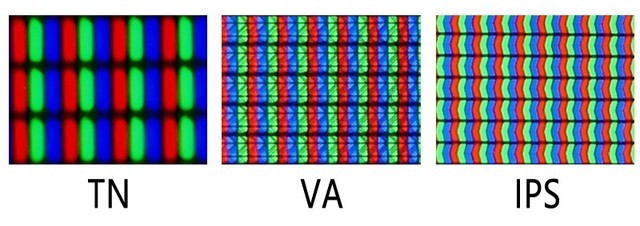
Pros of IPS panels:
- Best-in-class viewing angles – true 178°/178° with minimal color/brightness shift (ideal for multi-monitor setups, collaborative work, or sharing screens).
- Superior color accuracy and consistency – covers 95-100% sRGB easily, often DCI-P3 for pros; great for photo/video editing, design.
- Modern Fast IPS variants hit 1-4ms response times and 240Hz+ refresh rates, closing the gap with TN for gaming.
- Balanced overall – no major weak spots in most use cases.
Cons of IPS panels:
- Lower native contrast – usually 1000:1-1500:1, so blacks aren't as inky as VA.
- Can have IPS glow or backlight bleed in dark scenes.
- Slightly higher cost than TN or basic VA.
In 2025 guides from Rocktech, Screen Size Checker, and others, IPS is frequently picked as the best all-around for most gamers and creators. Fast IPS tech has made it viable even for competitive play, while pros love it for accurate colors.
PLS Panel (Plane to Line Switching) – Samsung's IPS Alternative
PLS is Samsung's proprietary tech, very similar to IPS but with tweaks for manufacturing. It's often grouped with IPS because performance is nearly identical.
Pros of PLS panels:
- Wide viewing angles and excellent color reproduction – matches or slightly beats standard IPS in some tests.
- Higher brightness in some implementations (10% more claimed in older claims).
- Potentially lower production costs, leading to competitive pricing.
- Good for large panels or TVs where efficiency matters.
Cons of PLS panels:
- Availability mostly in Samsung products.
- Response times and contrast similar to IPS – no huge edge.
- Sometimes minor differences in uniformity or glow.
From GamersNexus and older comparisons, PLS is basically "IPS but Samsung-branded," with occasional brightness perks. If you're eyeing a Samsung monitor, you're likely getting PLS under the hood.
So, Who Wins the Display Quality Battle in 2025?
- Best for competitive gaming/speed → TN (still unbeatable latency).
- Best for movies/dark content/contrast → VA (evolved from MVA).
- Best overall display quality (color + angles) → IPS (or PLS equivalents).
- Best balance for most people → Modern IPS LCD panels.
No panel is "perfect," but IPS comes closest for everyday use, creative work, and even gaming in 2025. That's why many turn to IPS LCD for reliable, vibrant results without compromises.
If you're in the market for something more specialized-like industrial controls, medical devices, kiosks, or custom sizes-standard off-the-shelf monitors might not cut it. That's where customization shines.


At Minghua Display, we specialize in customized LCD solutions, especially high-quality IPS LCD panels tailored to your exact needs. Whether you want specific brightness levels, touch integration, rugged designs, wide-temperature operation, or full branding on industrial LCD modules, Panel PCs, or portable monitors, our team handles low MOQs (starting at 100 pcs), fast prototyping (sometimes 48 hours for basics), and end-to-end turnkey devices. We've been building these since 2010, focusing on reliable supply chains and engineering support so your project looks and performs exactly as planned.
Thinking about upgrading or building something custom? Drop a comment or check out our options-happy to chat about how an IPS LCD from us could fit your setup perfectly.
What panel type are you rocking right now, and what do you use it for? Let me know below!


