

According to the latest report from TrendForce, global smartphone production in 2025 ended up pretty solid overall - about 1.254 billion units for the whole year, up 2.5% from the year before.
The fourth quarter was especially strong: 337 million phones made, up 2.7% from the previous quarter. Apple's new iPhones were the big driver there. Apple cranked out roughly 87 million units in Q4 alone - that's more than 50% higher than the quarter before, setting a new record for them in a single quarter.
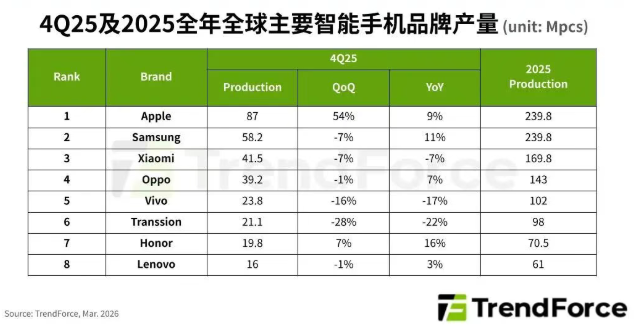
Samsung did about 58.2 million in Q4, which was up 11.1% year-over-year.
For the full year, both Apple and Samsung hit close to 240 million units each, tying for first place worldwide.
Xiaomi (including Redmi and POCO) came in third with almost 170 million for the year, though their Q4 production actually dropped about 7% from the previous quarter.
OPPO group (with OnePlus and Realme) landed around 143 million units for the year, taking fourth.
vivo (including iQOO) played it safe in Q4 and cut production by roughly 16% quarter-on-quarter.
Transsion (TECNO, Infinix, itel) slashed output big time in Q4 - down to just 21.1 million units, a 28% drop from the previous quarter.
Honor pushed hard at the end of the year and managed a 7% increase in Q4.
Lenovo (including Motorola) stayed basically flat in Q4, ending the year with around 61 million units overall, putting them eighth globally.
TrendForce said the first half of 2025 got a nice boost from various subsidy programs in China, and then the usual holiday shopping season helped in the second half.
But looking at 2026… it's not looking great. Memory chip prices have shot up a lot, which means phone manufacturing costs are jumping. They're now forecasting at least a 10% drop in global production volume, down to something like 1.135 billion units. Phone brands are stuck between a rock and a hard place: either raise prices to protect profits, or cheapen the specs to keep volumes up. Either way, the low-end market is probably going to get hit the hardest.


