

When people ask me about modern touchscreen tech, OGS display often comes up as one of those quiet workhorses that helped shape the slim phones and tablets we use today. I've worked with display solutions long enough to see how these technologies evolve-not just from spec sheets, but from actual projects where thickness, clarity, and cost all collide.
OGS, or One Glass Solution, isn't the newest or flashiest option anymore, but it still holds relevance in many applications. Let's walk through what it actually is, where it shines, where it struggles, and why it mattered in the first place.
Breaking Down What OGS Display Really Means
Traditional capacitive touchscreens used to be built like a sandwich: a display panel, a separate touch sensor on its own glass or film, and then the outer cover glass. That added thickness, extra adhesive layers, and more opportunities for light to bounce around and reduce clarity.
OGS display takes a different route. It integrates the touch sensor electrodes directly onto the inner surface of the cover glass itself. This "sensor-on-lens" method eliminates one entire glass layer. The result is a noticeably thinner module with better light transmission.
The manufacturing process starts with strengthening the cover glass, then depositing and patterning ITO (indium tin oxide) to create the touch grid, followed by precise cutting. Because the touch layer sits closer to the user's finger, signal strength tends to be strong, which translates to snappier response times.
I recall early implementations appearing more frequently around 2013–2016 in mid-to-high-end Android devices. Brands like Huawei and Meizu used OGS in several models to achieve bright, responsive screens without going full in-cell at the time.
How OGS Compares with In-Cell and On-Cell
This is usually the part people care about most when choosing technology.
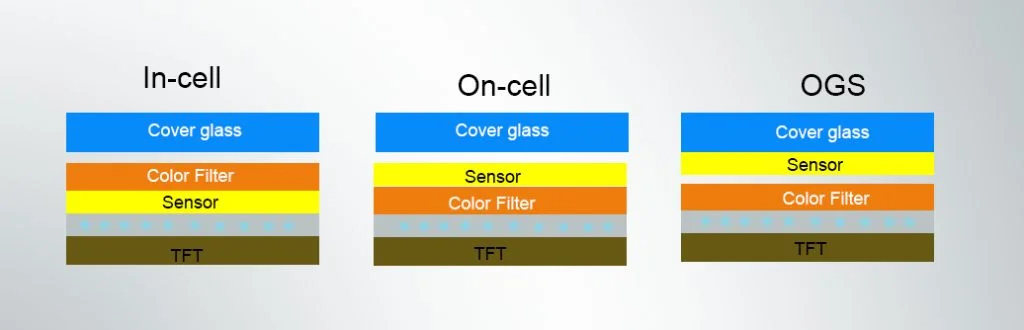
From the data I've reviewed across technical comparisons:
- Optical performance/transparency: OGS display generally leads. Fewer interfaces between layers mean less reflection and higher transmittance. Many sources rank it ahead of both In-Cell and On-Cell in visual clarity and color accuracy.
- Thinness: In-Cell wins here because the touch sensors are embedded directly within the display pixels. OGS comes in second, while traditional multi-layer approaches lag further behind.
- Touch sensitivity: OGS often performs best, followed by On-Cell. In-Cell can sometimes feel slightly less responsive unless the manufacturer invests heavily in signal-to-noise optimization.
- Durability and repair: On-Cell tends to handle impacts better. With OGS, if the cover glass cracks badly, you usually lose touch functionality entirely, since the sensors live on that same piece of glass. This is a notable practical drawback.
- Production reality: OGS has challenges with yield rates. Cutting chemically strengthened glass after patterning can create micro-cracks along the edges, lowering usable output and raising costs for smaller batches. In-Cell and On-Cell shift complexity to the panel manufacturers, which works better at massive scale but requires more advanced fabs.
In practice, OGS display struck a sweet spot for devices between 5 to 13 inches where optical quality mattered more than chasing the absolute thinnest profile. For flagship phones chasing sub-7mm thickness, In-Cell eventually took over.
Where OGS Display Still Makes Sense Today
Despite newer technologies, OGS hasn't disappeared. You'll still find it in:

- Mid-range tablets and industrial control panels
- Certain medical and automotive displays where consistent touch performance and good outdoor visibility are priorities
- Applications needing larger touch surfaces without the premium pricing of full In-Cell integration
One advantage that often gets overlooked is repair logistics in custom projects. While a broken OGS unit can be expensive to replace, the technology can be more straightforward to source for specific sizes compared to highly integrated In-Cell panels.
From a cost perspective, OGS can be competitive in medium volumes. It offers excellent brightness without needing as much backlight power, which helps with battery life in portable devices. Real-world tests from earlier generations showed OGS-equipped phones maintaining better visibility in direct sunlight compared to older GFF (Glass-Film-Film) designs.
The Honest Drawbacks
Let's not sugarcoat it. The main pain point with OGS display remains the single-glass dependency. Drop the device at the wrong angle and you risk losing both protection and touch in one go. Edge strength can also be compromised due to post-tempering cuts.
Manufacturing yields were historically lower than hoped, which limited its adoption in the most cost-sensitive segments. As panel makers poured resources into In-Cell for flagship models, OGS found its niche in applications where the balance of performance and feasibility still works.
Looking Ahead
The display industry keeps moving toward even more integrated and flexible solutions. Yet OGS principles-reducing layers for better optics-still influence hybrid approaches. We're seeing continued refinement in glass materials and coatings that could address some of the durability issues.
For many practical use cases outside ultra-premium consumer flagships, a well-executed OGS display remains a rational choice rather than chasing the bleeding edge.
If you're evaluating display options for a product and want something that delivers strong visuals without unnecessary complexity, it's worth considering where OGS display fits in the picture. Different projects have different priorities-sometimes the "good enough" technical solution that's reliable and cost-effective wins over the theoretically superior one.

At Minghua, we specialize in custom LCD solutions and work with clients to match the right touchscreen technology-whether OGS display or alternatives-to their exact requirements. From industrial equipment to specialized consumer devices, our team helps turn display specifications into working products that perform in the real world. Feel free to reach out if you're exploring options for your next project.


