

Hey , since you're probably dealing with tech/hardware stuff pretty often, I'll keep this straightforward-no fancy jargon overload, just real talk about why medical grade monitors aren't the same as the screens we use every day.
I've seen plenty of people get surprised by how much more expensive and "picky" these displays are. The short version is: when a radiologist is looking at a chest X-ray or a mammogram, they need to see extremely subtle differences in gray tones. If the screen is even slightly off-maybe the blacks aren't black enough, or one part of the screen is brighter than another-it can hide something important. That's not exaggeration; it's why hospitals pay 5–10× more for a proper medical LCD display instead of slapping a consumer 4K panel on a cart.
Normal monitors fade. Brightness drops after a year or two of heavy use, you start seeing uneven patches (mura), colors shift when you look from the side, and bright room lights wash everything out. In a reading room or OR, those problems aren't minor annoyances-they're risks.
So manufacturers build medical TFT displays (pretty much all of them are TFT active-matrix) with completely different priorities: long-term stability, insane uniformity, calibration that actually holds, and no flicker that tires out doctors' eyes after hours of staring.
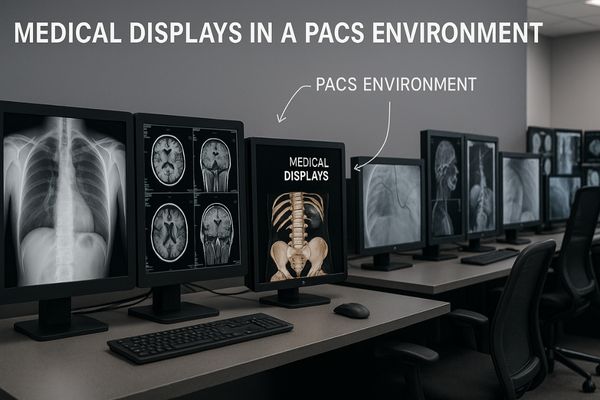
(Typical dual-screen PACS workstation – this is what radiologists actually sit in front of every day.)
(4MP dual-head diagnostic monitor setup – very common in hospital reading rooms.)

The Rules They Have to Follow
The biggest one everyone talks about is DICOM Part 14 GSDF. It's basically a curve that says "this shade of gray should look exactly this bright to the human eye." They call the steps Just Noticeable Differences (JND). If the monitor doesn't follow that curve closely, the image isn't trustworthy anymore after a while.

There are also safety standards like IEC 60601-1 (the current edition is stricter on electrical noise and interference), UL certification, and sometimes IP ratings so staff can wipe the screen with disinfectants without worrying.
In the US and Europe you can't really sell into hospitals without hitting these. Even in places that don't force full medical-device registration, the buyers still want to see DICOM certificates and proof that brightness won't drop too much after 30,000–50,000 hours.
All those rules force the LCD panel maker to do things like support very fine calibration tables, drive the screen at 10-bit or 12-bit grayscale, and add sensors that keep the backlight steady automatically.
Quick Side-by-Side: Medical vs Everyday LCD
Here's what you actually get when you pay for medical-grade:
- Resolution – Consumer: 1080p or basic 4K. Medical: usually 5MP (2048×2560) or 8MP, sometimes higher for breast imaging.
- Grayscale levels – Consumer: 8-bit (256 shades). Medical: 10-bit minimum, often 12-bit (1,024 or 4,096 levels) so you don't see banding.
- Brightness – Consumer: 250–400 nits. Medical: native 600–1,300 nits, stays stable around 350–500 nits for years.
- Uniformity – Medical panels must pass AAPM TG-18 tests. No visible bright/dark spots, especially side-by-side.
- Viewing angle – IPS everywhere, 178° with basically no shift.
- Color (when it's needed) – Wide gamut and very tight Delta E for ultrasound, pathology, endoscopy.
- Backlight – LED + sensors that auto-correct. No PWM flicker.
- Lifespan & build – High MTBF, usually no fan, sometimes antimicrobial bezel.
It's not about being "better looking"; it's about the image staying trustworthy after thousands of hours.
The Hard Parts of Actually Making These Panels
It's not just turning up the brightness knob. A few things are genuinely difficult:
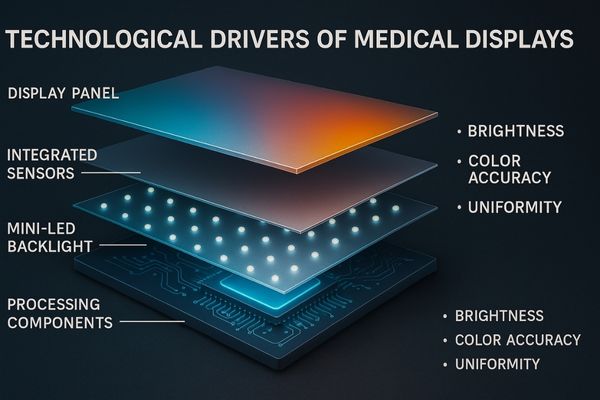
- Backlight drift: they build in sensors that check brightness constantly and adjust so it doesn't wander.
- Flicker: PWM dimming is banned because it causes eye strain over long shifts.
- Glare: anti-reflection coatings so OR lights or windows don't ruin visibility.
- Uniformity across batches: when you put three screens next to each other, they better match perfectly.
- Dust & cleaning: fanless, sealed designs so nothing gets inside.
Companies solve this with better electronics, custom films, and a ridiculous amount of testing (burn-in chambers, temperature/humidity cycling, etc.). The panels that survive really do run reliably for 5–10 years in 24/7 environments.
Where They Actually Get Used
- Radiology reading: 21.3" 5MP or 27" 8MP, usually two screens portrait mode.
- Mammography: high-contrast (sometimes monochrome) for 3D tomosynthesis.
- Surgery/OR: 4K high-bright, often touch-enabled.
- Mobile carts/bedside: 15–24" that are easy to clean and work with gloves.
21–32 inch is most common for diagnosis; bigger ones (42–55") show up in operating rooms.
What's Changing in the Next Few Years
- Resolution keeps climbing: 8MP is normal now, 12MP+ is appearing for very detailed work.
- Color demand is growing fast: ultrasound, pathology, endoscopy all want accurate wide-gamut.
- Built-in smarts: auto-calibration, room-light sensors, some early AI contrast tweaks.
- Mini-LED backlights: much deeper blacks and better contrast without OLED's burn-in risk. LCD still wins on cost and proven life.
- More local supply: especially in Asia, domestic factories are ramping up to shorten lead times.
LCD isn't disappearing anytime soon-it's reliable, doesn't burn in, and the manufacturing is very mature.
Bottom Line: What to Actually Care About When Buying
Don't just look at megapixels. Ask vendors for:
- DICOM compliance proof (out of the box)
- Brightness stability data over 30,000–50,000 hours
- AAPM TG-18 uniformity reports
- Batch matching if you're doing multi-monitor setups
The smartest thing is to work with someone who already knows medical specs. They can tune brightness, add coatings, guarantee uniformity across panels, and give you the paperwork for certification.
If you're hunting for custom medical LCD display panels, take a look at Minghua Display.
We specialize in TFT modules made for medical use-resolution tuning, brightness curves dialed in, DICOM pre-calibration from the factory, anti-glare/low-reflection surfaces, wide-angle IPS, touch or sensor integration, 10/12-bit grayscale, stable backlights that auto-adjust, and really tight batch uniformity so multi-screen setups don't look mismatched.
We build to IEC 60601 and DICOM Part 14, handle prototypes through volume production, keep MOQs reasonable, and move fast. A bunch of OEMs and integrators use us because we deliver stable panels without the usual certification nightmares or early failures. If you're designing a diagnostic station, surgical monitor, patient display, or endoscopy system, shoot us a message. We can send samples, full datasheets, or talk specs. Happy to help make sure the screens actually do what the doctors need them to do.


