

If you've ever tried checking a display outdoors on a bright day, you know the frustration. The screen washes out, reflections make it impossible to read, and you end up squinting or shielding it with your hand. That's exactly why high brightness screens have become so important for everything from industrial machines and medical equipment to car dashboards and outdoor kiosks.

Standard LCDs sitting around 300-500 nits just don't cut it when the sun is beating down. You need something that delivers real sunlight readability-often 1000 nits and up-without turning into a power-hungry heater that drains batteries or complicates cooling.
Over the years working with engineers and procurement teams, I've seen that the smartest improvements come from optimizing the backlight and optical stack rather than just cranking up the LEDs. Let's walk through what actually works in practice
Why the Push for High Brightness Screens Keeps Growing
More and more equipment is moving into challenging environments. Think self-service terminals at gas stations, factory floor monitors near windows, marine displays, or vehicle systems. Ambient light can easily hit thousands of lux, completely overwhelming a normal panel.
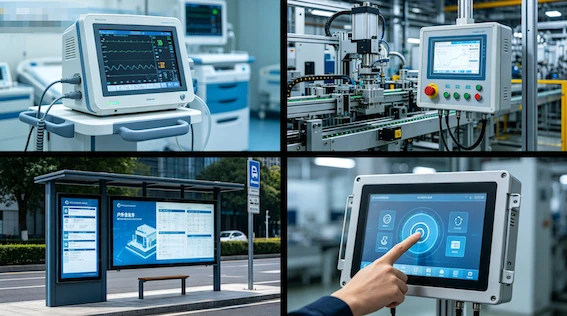
The common complaints I hear are familiar: "Can't read it in sunlight," "Too much glare," or "It gets way too hot when we boost brightness." These issues lead to safety risks in industrial settings, customer frustration at kiosks, and higher failure rates overall.
High brightness screens solve this by maintaining clear visibility while keeping power and heat under control. The key isn't brute force-it's smarter light management.
What Really Controls Brightness in an LCD?
Most people assume brightness is all about LED power. That's only part of the story. The entire backlight system has to work together efficiently: generating light, guiding it, recycling what would be lost, and directing it toward the viewer.

Typical components include the LED light bars, light guide plate, diffuser films, brightness enhancement films, and the reflector at the back. Lose light at any stage and you're wasting energy. Good high brightness screens focus on minimizing those losses so you get more output from the same (or less) input power
Starting with Better LEDs
One of the most straightforward upgrades is switching to higher-efficiency LEDs. Regular ones might hit 90-110 lm/W, while better chips today comfortably reach 140-180 lm/W or more. That difference adds up quickly-more light per watt means you can hit higher nits without proportionally increasing current.

Placement and layout matter too. Edge-lit designs keep things slim and work well for many applications, but direct-lit can deliver stronger peak brightness and better uniformity for larger or truly outdoor panels. Fine-tuning the array spacing and thermal paths helps avoid hot spots that dim performance over time.
Making the Most of Optical Films
This is where a lot of "free" gains come from. Optical films manage light that would otherwise scatter or get absorbed.
Brightness Enhancement Films (BEF) use tiny prisms to recycle off-angle light back into the useful viewing cone. A single layer can boost on-axis brightness noticeably; stacking them cleverly pushes it further.
Dual Brightness Enhancement Films (DBEF) take it up another level by handling polarization. LCDs normally waste a lot of light due to polarization mismatch-these films recycle the wrong polarization instead of letting it disappear as heat. Gains of 20-40% in effective light utilization aren't unusual.
Diffuser sheets also deserve attention. The right ones improve uniformity, cut down on bright spots or mura, and pair better with the enhancement layers. When everything is tuned together, the whole system feels more efficient.
Don't Overlook the Reflector
A high-quality reflector at the back of the module is surprisingly impactful. Materials like 3M's ESR films or upgraded white PET can reflect 98% or more of the light. Swapping in better reflectors has delivered 15-30% brightness improvements in real projects I've seen, often with almost no extra power or cost. It keeps stray light in play instead of letting it disappear.
Light Guide Plate Optimization
For edge-lit designs especially, the light guide plate (LGP) is critical. Older plates with simple printed dots lose efficiency and create uneven brightness-dark edges or hot centers.
Modern approaches use laser etching, precision V-cuts, or nano-textures to extract light more controllably. A well-designed LGP reduces edge dark zones and lets you achieve target brightness with fewer or lower-power LEDs. Uniformity improves dramatically, which is huge for professional and outdoor use.
Optical Bonding: A Game-Changer for Real-World Visibility
Even if your measured nits in a dark room stay the same, optical bonding can make the screen look and perform much better outdoors. By filling the air gap between the LCD and cover glass with optically clear adhesive, you eliminate multiple internal reflections that steal light and create glare.

The result is higher effective contrast, less washout in sunlight, and better durability. Many sunlight readable displays rely on this technique to turn good lab numbers into excellent field performance.
When Standard Power Isn't Enough: External Backlight Drivers
A lot of integrated motherboard supplies and drivers hit limits on current or control precision. For sustained 2000-5000 nits operation, an external constant-current driver often makes more sense.
These dedicated supplies offer stable high output, precise PWM dimming, and built-in protections. They decouple the backlight from the main system electronics, giving designers more headroom while keeping things reliable.
The Real Engineering Challenges
Pushing brightness brings trade-offs. Heat is the biggest one-LEDs convert a lot of energy to thermal load, so proper heatsinking, materials, and sometimes airflow design are essential to avoid brightness droop or shortened lifespan.
EMI can also creep up with higher currents or fast switching. Careful layout and shielding help there. And of course, many industrial or portable systems have strict power budgets, which is why efficiency across the whole optical path matters so much.
Real Solutions from Minghua Display
At Minghua Display, we've helped many customers tackle these exact issues through custom high brightness LCD solutions. We work with 1000 to 5000 nits designs tailored to specific environments-whether it's rugged outdoor kiosks, industrial panels, or vehicle applications.
Our approach includes custom LED bars with high-efficiency chips, full optical film stacks optimized for the application, advanced light guide development, optical bonding for superior readability, and external driver options when needed. We focus on balancing brightness, power consumption, heat, and reliability rather than just chasing headline nits numbers.


If you're an engineer refining a design, a procurement specialist sourcing reliable panels, or an OEM building equipment that needs to perform in tough lighting, we'd love to talk. Custom LCD work is what we do best, and we've seen how the right optimizations turn frustrating displays into dependable ones that users actually trust.
Wrapping It Up
The strongest high brightness screens aren't the ones that simply throw more power at the problem. They're the ones that squeeze maximum performance from every photon through smart backlight architecture, quality materials, and thoughtful system design. This efficiency-focused path delivers better visibility, lower running costs, and more reliable operation in the real world.
Whether you're dealing with sunlight readable needs today or planning for future projects, focusing on these areas usually yields the best results.
FAQ
Q: What counts as a high brightness screen?
A: Generally anything 1000 nits and above. True sunlight-readable models often target 1500–5000 nits depending on the environment.
Q: Can you really improve LCD brightness without raising power consumption much?
A: Absolutely. Better LEDs, optical films (BEF/DBEF), improved reflectors, and smarter light guides can boost effective output significantly through higher utilization rather than raw power.
Q: What backlight approach works best for outdoor displays?
A: It depends on size and requirements. Optimized edge-lit with advanced films keeps things thin and efficient for many cases, while direct-lit often excels for maximum uniform brightness in larger panels.
Q: Why use external power supplies for some high brightness screens?
A: They overcome limitations in standard board-level drivers, providing higher stable current, better dimming control, and support for sustained high-output operation.
Ready to make your displays stand out in any lighting? Reach out to the team at Minghua Display. As specialists in custom LCD solutions, we help turn standard panels into high-performance high brightness screens built exactly for your application. Let's create something that works brilliantly where it matters most.


