

Hi everyone, David Chen here, Engineering Director at Minghua.
After working on custom LCD projects for more than eight years, I've learned that the biggest difference between a successful product launch and a frustrating, expensive mess usually comes down to one thing: how well the development process is managed.
I've seen projects that started with great enthusiasm completely fall apart, and I've also seen highly demanding requirements turn into smooth, reliable production because we followed a disciplined, practical approach. In this article, I want to give you a transparent look at how we actually handle the custom LCD development process at Minghua - from the very first conversation to stable mass production.
This is the real workflow we use day in and day out.
Why a Proper Process Makes Such a Big Difference
Many companies think that if the sample looks okay, the rest will be easy. Unfortunately, that's rarely the case with custom displays. Without a solid process, you often end up with inconsistent quality, missed deadlines, failed certifications, or products that work in the lab but fail in the field.
A well-structured custom LCD manufacturing process helps control risk, manage cost, and deliver a display that performs reliably for years. Over time, we've built and refined our own process specifically to make this journey less painful and more predictable for our customers.
Our Real Custom LCD Development Process
Here's how we typically take a project from initial concept all the way to mass production.
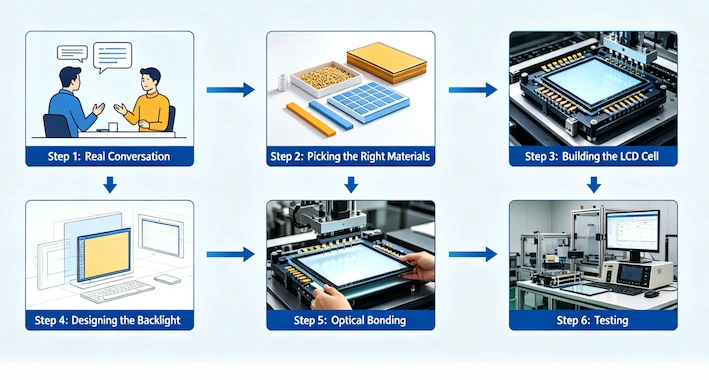
Stage 1: Deep Requirement Understanding
We start by asking a lot of questions. It's not just about taking your spec sheet. We need to understand the real environment - Will this display sit outdoors in direct sunlight? Will it be mounted on vibrating machinery? Is it for a medical device that needs to work perfectly every single time?
Often, customers come in asking for very high brightness, but after discussion we realize that combining moderate brightness with optical bonding actually gives better real-world visibility and lower power consumption. Catching these insights early saves a lot of time and money later.
Stage 2: Technical Design & Simulation
Once we're aligned on the requirements, our engineers get to work on optical simulations, backlight design, material selection, and circuit planning. We try to predict performance as accurately as possible before building anything physical.
I always remind the team that good simulation work now prevents multiple rounds of painful revisions down the line. This stage has improved a lot over the years as we've accumulated more real project data.
Stage 3: First Prototypes and Samples
This is the stage most customers look forward to. For most projects, we can deliver initial working samples in 3 to 5 weeks. Sometimes we build two or three variations so you can compare performance and appearance directly.
I still remember one medical project where the customer really disliked the first sample's color tone. We adjusted the backlight and polarizers, and within two weeks they got exactly what they wanted. Fast feedback like this only happens when you have strong in-house engineering and production capability.
Stage 4: Validation and Serious Testing
This is where we put the prototypes through their paces. Temperature cycling from -40°C to +85°C, humidity testing, vibration, shock, long-term aging, optical measurements - we do it all.
For medical and automotive projects, we also support the full certification process, including ISO 13485 and IATF 16949. It takes time and effort, but it greatly reduces the chance of nasty surprises when the product reaches the market.
Stage 5: Pilot Run – Testing the Real Process
Before jumping into full mass production, we run a pilot batch, usually between 100 and 500 pieces. This stage is incredibly valuable because problems that don't show up in a few samples often appear when you start making more.
We use the pilot run to fine-tune processes, improve yield, and lock in final inspection standards. Many customers have told me this step gave them real confidence before committing to larger volumes.
Stage 6: Preparing for Mass Production
Once the pilot run goes well, we finalize all the tooling, production fixtures, operator training, and quality control procedures. We set up dedicated inspection points for your specific product to ensure consistency.
The goal here is simple: we want the 1,000th piece to look and perform as well as the 10th piece.
Stage 7: Stable Mass Production and Long-term Support
When full production begins, our responsibility continues. We provide regular quality reports, maintain safety stock when needed, and keep technical support available throughout the product's entire lifecycle. Some of our displays have been running smoothly in production for over six years now.
Technologies We Use Throughout the Process
During these stages we often apply technologies such as optical bonding for superior contrast and durability, high-brightness backlights with proper thermal management, wide-temperature liquid crystal materials, custom touch integration, and effective EMI shielding. These solutions are considered from the beginning, not added as an afterthought.
A Typical Project Timeline
Last year we finished an industrial handheld device project with the following timeline:
- Weeks 1–3: Requirement collection and feasibility study
- Weeks 4–7: Design and first samples
- Weeks 8–11: Testing and improvements
- Weeks 12–15: Pilot run (around 300 pieces)
- Week 18 onward: Mass production
From kickoff to first mass production delivery, it took roughly five months. That's actually quite reasonable for a fully custom industrial solution.
Challenges We Face and How We Handle Them
Not every project is smooth. Sometimes we struggle to balance high brightness with heat, or wide temperature performance with good contrast. Cost pressure is always present.
What makes the difference is experience. After doing this for many years, we've learned how to have honest conversations with customers early so we can find the best possible trade-offs together.
Ready to Move Forward with Your Custom LCD Project?
Developing a custom display can feel complicated, but with the right custom LCD development process and the right partner, it becomes much more manageable and predictable.
At Minghua, we specialize in custom LCD manufacturing. We support customers across medical, industrial, automotive, marine, and outdoor applications with full end-to-end service - from early concept discussions through to stable mass production and long-term supply.

If you have a project in mind, whether it's still just an idea or you're looking to improve an existing design, we'd be happy to have an open conversation about it. Reach out anytime for a technical discussion. No pressure, just practical advice from engineers who do this every day.
- David Chen Engineering Director, Minghua Display Technology


