

Hey, let's clear up a super common mix-up: LCD vs LED. People throw these terms around like they're rival screen technologies, but the truth is way simpler-and kinda funny once you get it.
First, the Basics: What Even Are These Things?
LCD stands for Liquid Crystal Display.
It's the tech behind basically every TV, laptop, monitor, and phone screen you've touched in the past 15 years.
The "liquid crystals" are these tiny shutters that twist to control light passing through them. Cool, right?
But here's the catch: LCD panels don't make their own light.
They need a backlight to shine through the crystals so you can see the picture.
Enter LED-short for Light Emitting Diode.
Now, when someone says "LED TV" or "LED monitor," they're not talking about a completely different screen.
They mean an LCD screen that uses LEDs as the backlight instead of the old fluorescent tubes (called CCFL-Cold Cathode Fluorescent Lamps).
So really, LCD vs LED isn't a real fight-it's like arguing "gas car vs turbo gas car."
Same engine, better boost.
So What's Actually Different in LCD vs LED?
It all comes down to that backlight. Let's break it down like you're shopping for a new TV:
| Feature | Traditional LCD (CCFL backlight) | LED-backlit LCD (aka "LED TV") |
|---|---|---|
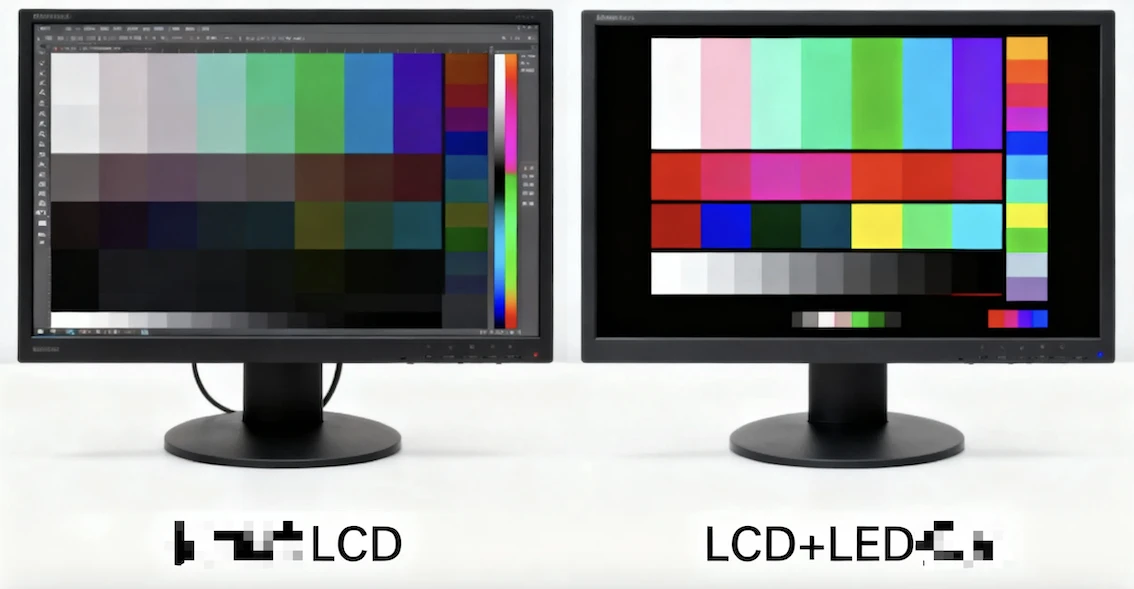
| Color Pop | Fine, but kinda flat | Chef's kiss-richer reds, deeper greens, 30–50% wider color gamut |
| Viewing Angle | Shift 30° and colors wash out | Up to 160°-looks great even if you're sprawled on the couch |
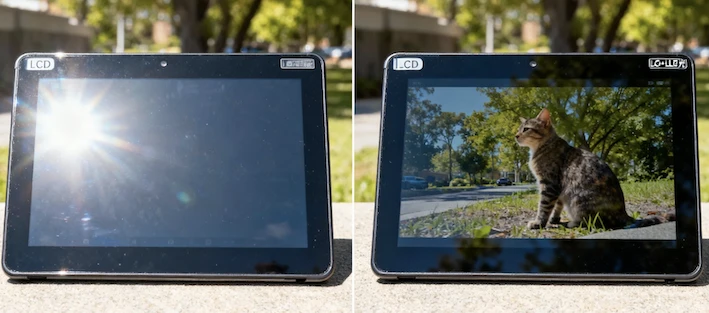
| Brightness | Decent indoors | Sun-proof-1000x faster pixel response, readable in direct sunlight |
| Price | Budget king | 10–20% more, but prices are crashing |
| Power Draw | Thirsty (10:1 ratio vs LED) | Sips power-huge for laptops, wall-sized displays |
| Thickness | Chunky backlight = bulky bezels | Razor-thin-some TVs are under 5mm |
| Refresh Rate | 60–120Hz typical | 240Hz+ gaming monitors are common |
| Contrast | Max ~350:1 | Mini-LED versions hit 1,000,000:1 with local dimming |
| Cold Tolerance | Freezes up below 0°C | Works down to –40°C (think outdoor kiosks) |
| Lifespan | 30,000–50,000 hours | 100,000+ hours-literally decades |
Real Talk: Where Do You Actually See LCD vs LED?
Let's go beyond the spec sheet and look at where these shine (pun intended):
1. Control Rooms & Security Walls
Winner: Traditional LCD splicing screens
You've seen those giant video walls in airports or police stations? 90% are LCD panels with CCFL or basic edge-lit LED.
Why? You can tile 50 screens into a 4K wall for under $20K. Using full LED screens (like outdoor billboards) would cost 10x more and blind everyone with brightness.
LCD vs LED here? LCD wins on cost and control.
2. Conference Rooms & Presentations
Winner: LED-backlit LCD
Ever notice how slides look vivid in a boardroom?
That's LED backlighting with wide color gamut.
No one wants the CEO squinting at washed-out charts. Plus, LCD vs LED in meetings?
LED's wider viewing angles mean the intern in the corner sees the same colors as the boss.
3. Outdoor Billboards & Stadiums
Winner: Direct-view LED (not backlit!)
Okay, this is where "LED display" means something different.
These are grids of RGB LEDs-no LCD layer at all.
Think Times Square. Brightness? 10,000 nits. Weatherproof? Yep.
But for your average mall kiosk, an LED-backlit LCD is plenty.
4. Your Living Room
Reality: It's 99% LED-backlit LCD
Unless you dropped $2,000 on an OLED, your "LED TV" is an LCD panel with LED backlight-probably mini-LED if it's 2025.
Brands love the LCD vs LED confusion;
it lets them charge $800 for a $600 panel with better lights.
5. Gaming & Esports (2025 Edition)
Winner: Mini-LED LCD
480Hz monitors with 1,000+ dimming zones?
That's LCD vs LED on steroids.
The liquid crystals switch fast, but the mini-LED backlight delivers OLED-level blacks without burn-in risk.
Response time? 0.5ms. Glare?
BOE's anti-reflective coating drops it to 0.7%.
Gamers don't care about the debate-they just want 240 FPS without tearing.
6. Laptops & Portables
Winner: Edge-lit LED LCD
Your MacBook's screen? LCD with LED backlight, under 1mm thick, 99g.
Battery lasts 12 hours because LEDs sip power.
LCD vs LED in ultrabooks? LED made thin-and-light possible.
The Tech That's Blurring LCD vs LED Even More
Let's talk Mini-LED-the glow-up that's making LCD vs LED debates obsolete.
What it is: Thousands of tiny LEDs (0.1mm) behind the LCD panel, each controlling a small zone.
Why it rules: Contrast jumps to 1,000,000:1, blacks are deep, and brightness hits 6,000 nits.
2025 stats: TCL shipped 1.37 million mini-LED TVs in H1. A 65-inch model? ~$1,200. Same-size OLED? $2,000.
Pro tip: Mini-LED is still LCD-just with a way smarter backlight.
Other cool tricks:
Corning's 0.4mm glass → Foldable LCD prototypes (yes, really).
Quantum dots + LED backlight → 100% DCI-P3 color without OLED's burn-in.
Low-reflection coatings → Outdoor menus that don't turn into mirrors at noon.
Eco & Industrial Wins (Because Someone Has to Care)
Power: LED-backlit LCDs use 60–70% less energy than CCFL. A 55-inch TV went from 150W to 60W in a decade.
No mercury: Old CCFL tubes had toxic gas. LEDs? Clean.
Recycling: Chinese firms now reuse 90% of LCD chemical waste-turning "polluter" into "green tech."
Industrial use: Shenzhen factories use LCD screens that run at 85°C to monitor robots. Try that with OLED.
The Big Picture (No Hype)
LCD vs LED isn't a versus-it's an and.
LCD is the canvas; LED is the paintbrush.
Together, they've crushed plasma, kicked CCFL to the curb, and now mini-LED is nipping at OLED's heels.
In 2025, your "LED TV" is an LCD screen with a fancy backlight.
Your phone? Same. That giant airport display? LCD tiles with LED zones.
The only true "LED display" is the one in Times Square-and even that might use LCD for control panels.
Bottom line: Stop overthinking LCD vs LED. Just ask:
"Do I need crazy brightness?" → LED backlight.
"Am I tiling 50 screens?" → Classic LCD.
"Do I game at 500 FPS?" → Mini-LED LCD.
The tech's evolved, but the core truth hasn't: LCD needs light. LED delivers it better. And together? They're unstoppable.


